
Chains Ropes and Restraints in Tarot Imagery
This article examines how chains, ropes, and other restraints function as visual language in Tarot, using The Hanged Man, The Devil, and the 8 of Swords as primary case studies. It explains how to distinguish literal from symbolic bondage, how restraint motifs interact with card suits and major arcana themes, offers step-by-step reading techniques and example narratives, and lists common interpretive errors to avoid.
Cards explored in this article
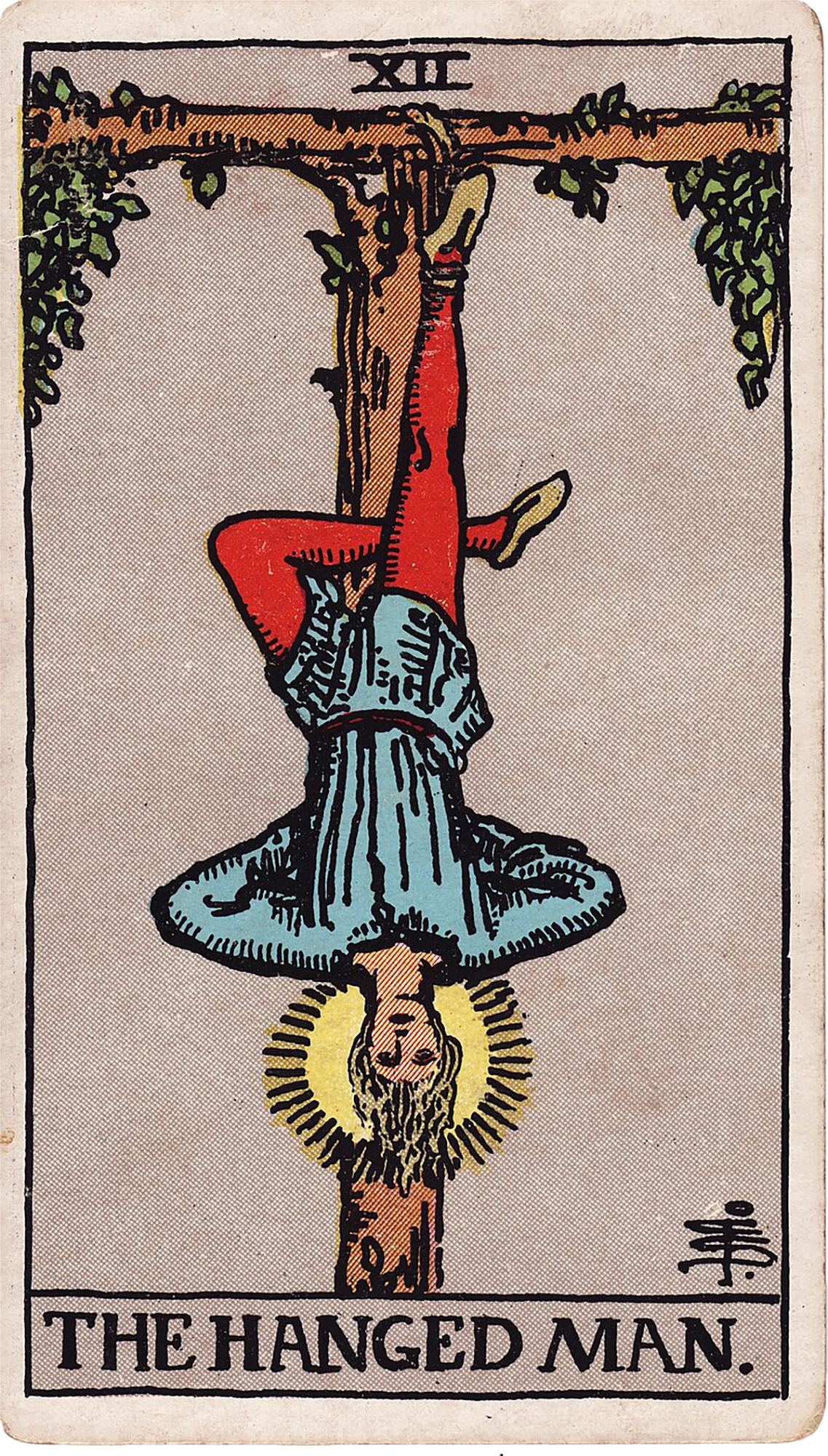 The Hanged Man
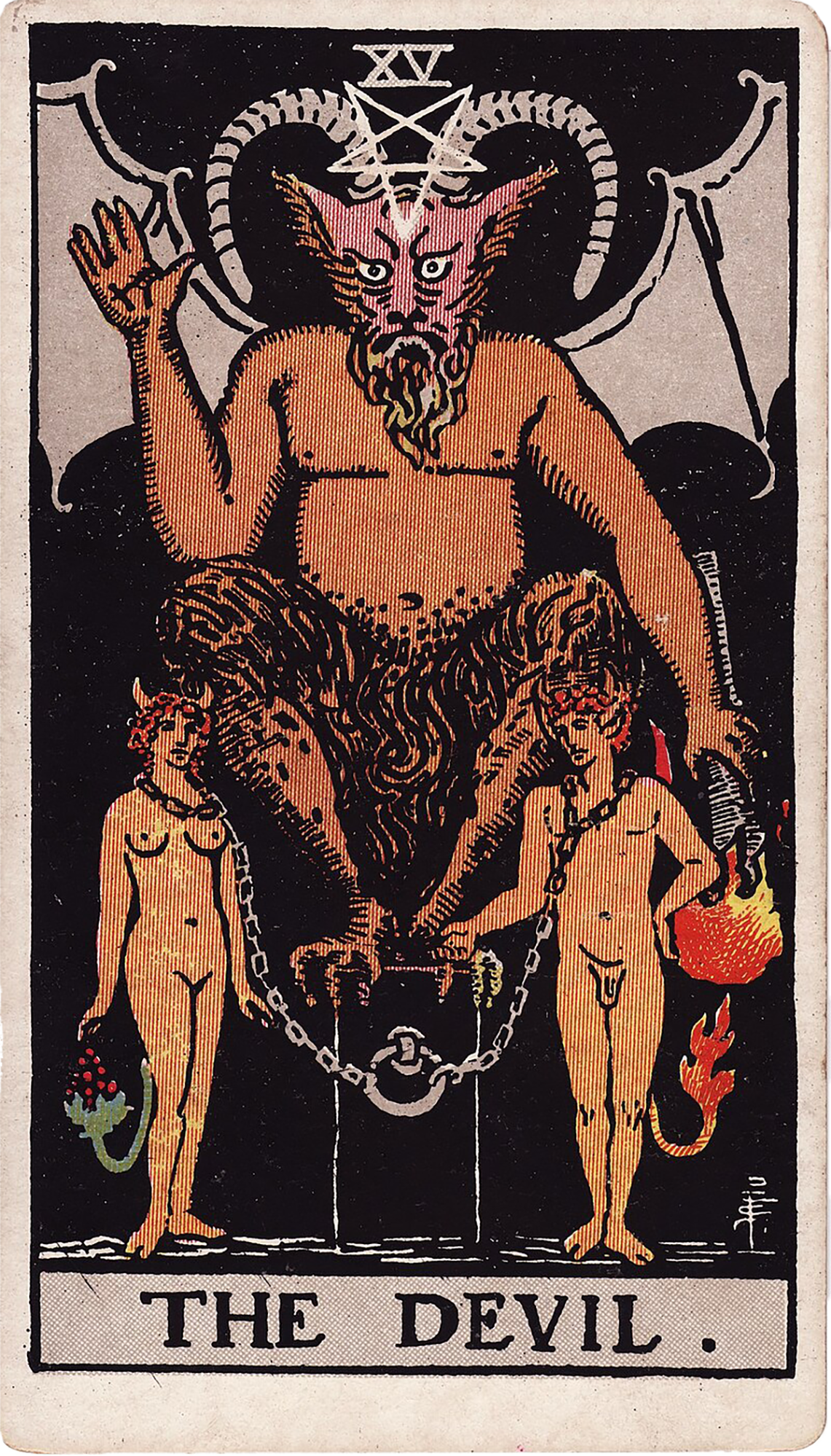 The Devil
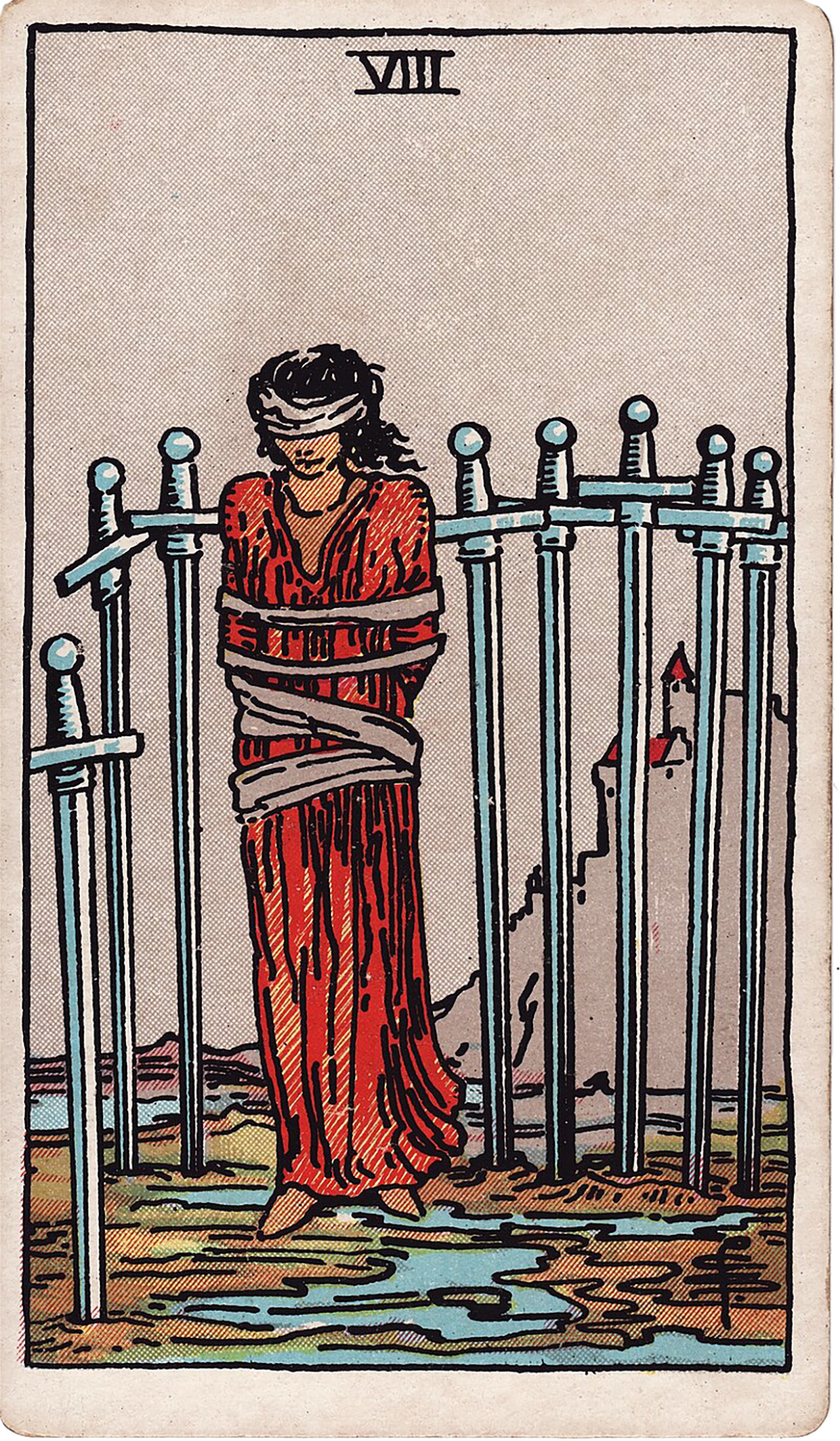 8 of Swords
Introduction: Why restraints matter in tarot symbolism
Restraints — chains, ropes, fetters, bonds, blindfolds — are one of the most direct visual devices a card artist can use to communicate limitation, attachment, suspension, or control. They are also unusually flexible as symbols: a cord can represent a social bond, a habit, a legal tie, an internal belief that feels binding, or a physical constraint. In Rider-Waite-Smith (RWS) imagery these devices are deliberate and patterned. Learning to read them well means learning to separate surface details (a rope around a wrist) from structural meaning (what the rope is doing to agency, perception, or identity in the scene). This article uses three supplied cards as its primary anchors: The Hanged Man, The Devil, and the 8 of Swords. Each card shows a different variety of restraint and a different semantic range. We will repeatedly return to those images and to conventional RWS meanings so the patterns become practical for reading rather than merely descriptive.
A visual vocabulary of restraints
Begin by cataloguing the types of restraints you may encounter and what they commonly suggest. - Ropes and cords: organic, flexible ties. In RWS they often imply voluntary or negotiable restraint — something that can be untied or adjusted, or that the querent may have wrapped themselves into. The Hanged Man is suspended by a rope tied to a tree limb and to his foot, a visual that leans toward an intentional, oriented pause rather than raw oppression. - Chains and metal fetters: heavier, mechanical, more institutional. The Devil's two human figures wear metal chains around their necks; the chains visually nod to bondage that looks enforced and social. Metal calls to systems, structures, or internalized fears that feel ironclad. - Blindfolds and gags: restraint of perception or voice. The 8 of Swords shows a woman both blindfolded and bound; the blindfold points directly to an epistemic problem — inability to see options — while the bindings invite analysis of the actual degree of restriction (loose ribbons versus tight straps). - Suspension: hanging, tying above, or being held up emphasizes a temporal state or deliberate pause. The Hanged Man's suspension communicates a willingly adopted inversion in perspective. Suspension symbolizes interruption of ordinary movement. - Location matters: a bond around the hands suggests limited doing; around the neck suggests speech or identity; around the feet suggests mobility. The Hanged Man is bound at a foot; the Devil binds at necks; the 8 of Swords binds hands and limbs.
Major Arcana vs Minor suits: different scales of bondage
In tarot, the Major Arcana tend to point to archetypal forces and life-shaping dynamics, while the Minor Arcana describe situational or psychological processes. That distinction affects how restraint motifs are read. - Major Arcana restraint (The Hanged Man, The Devil): These images are about identity, orientation, and fundamental patterns. The Devil's chains often symbolize shadow patterns, systemic attachments, and the seductive quality of bondage. The Hanged Man's suspension addresses surrender, liminality, and paradox — a necessary inversion to see differently. - Minor Arcana restraint (8 of Swords in Swords suit): When a restraint appears in a suit card, the reading often narrows to a domain: Swords speak of thought, perception, communication, and choice. The 8 of Swords uses a binding motif to depict cognitive entrapment — beliefs and fears constructing a felt cage. Such cards ask: which skills of the suit will resolve it? For the 8 of Swords, the work involves truth, strategy, and the disciplined use of reason. Reading technique: anchor to the scale. If the Devil appears with the 8 of Swords, treat the problem as both archetypal attachment and a pattern enacted in thinking. If The Hanged Man appears, ask whether what looks like a bond is actually a chosen pause for perspective.
Close reading: The Hanged Man
Visual anchors: a man suspended by one foot from a T-shaped tree or crosspiece, rope around ankle, other leg crossed, halo around his head. In RWS the Hanged Man is often understood as voluntary suspension, an intentional inversion, spiritual insight developing through pause. What the restraint shows here: The rope ties him to an enforced stillness, but the posture is composed and neither distressed nor violent. The single-point suspension highlights the deliberate reorientation of perception. The halo indicates conscious clarity or spiritual reframing gained through the state. Interpretive lines: Upright, the Hanged Man emphasizes pausing deliberately, releasing control, and allowing a different perspective to transform understanding. The bound foot becomes less a mark of helplessness and more an instrument of chosen limitation for a greater end. Reversed, the Hanged Man can point to stagnation, martyrdom, or refusal to learn from the pause — the rope is still there but used unconsciously. Practical read: When The Hanged Man appears, isolate whether the rope is external or self-arranged. Ask: Is this pause chosen? Is the querent using the suspension constructively? Ask clients which ‘rope’ they could loosen voluntarily to let new sight emerge. Phrase coaching language carefully: 'Where could a deliberate pause give you perspective?' rather than 'You are stuck.'
Close reading: The Devil
Visual anchors: a horned, winged figure perched above two chained human figures; the chains are looped around their necks but appear loose; the humans often have animal-like attributes in some decks; the Devil carries a torch or a caduceus-like symbol in RWS variations. What the chains show here: The Devil's chains carry a social and psychological weight. They often imply bondage that looks externally imposed but is secretly accepted or internalized. The apparent looseness of the chains is crucial in RWS: it suggests that the power of the Devil figure depends on the humans' consent or habit. Interpretive lines: Upright, The Devil names unhealthy attachments, suppressed desires, and forms of bondage that hide in the pleasures of the moment. It calls for naming and boundary-setting. Reversed, it may point to breaking patterns or the danger of declaring freedom prematurely without changing what recreates the attachment. Practical read: Use the image to distinguish where a client feels coerced by a system versus where they are performing compulsion. Ask: 'Who is holding the chain, and why do you keep wearing it?' Encourage language that recognizes agency: 'What would it take to set those chains down?' Also test neighboring cards to see if the Devil points to a systemic external force or an internalized habit.
Close reading: 8 of Swords
Visual anchors: a blindfolded woman, bound with loose cloth or sandals, standing in a bog or marsh, surrounded by eight upright swords forming a fence. Unlike metal chains, her bindings look like strips of cloth or rope; the scene suggests constrained movement rather than physical imprisonment. What the restraints show here: The 8 of Swords is a card of mental restriction. The bandages over eyes and the cords at the limbs work together to communicate inability to perceive options. The swords create a conceptual cage, while the loose ties suggest that the bondage is negotiable if perspective changes. Interpretive lines: Upright, the card highlights feeling trapped by circumstances or beliefs; the loose bindings mean some restrictions are more negotiable than they appear. Reversed, the card focuses on release, new perspective, or relapse into fear after an initial breakthrough. Practical read: With this card, focus on clarifying options. Ask the querent to name what they assume they cannot do and then test that assumption with concrete micro-actions. Because this is Swords energy, encourage exercises that move thought and speech — writing pros/cons, listing choices aloud, negotiating language that reframes constraints.
Comparative interpretation: how these three cards talk to one another
These three cards form an instructive triad: The Hanged Man models voluntary suspension, The Devil shows systemic or shadow companionship with bondage, and the 8 of Swords depicts cognitive entrapment. Watching how restraint motifs shift between them gives you reading leverage. Common combinations and their logic: - The Hanged Man + The Devil: This pairing often points to paradoxical consent. Either the querent is choosing a pause that paradoxically reinforces attachment, or the pause reveals an underlying dependency disguised as a spiritual practice. Read the rope (Hanged Man) as the querent's choice and the chains (Devil) as the pattern being examined. Ask: Is the pause liberating or enabling? - The Devil + 8 of Swords: This reads as shadow-meets-cognition. The Devil supplies the pattern or desire; the 8 of Swords shows how that pattern has been intellectualized into a self-limiting story. Interpretation technique: follow the chain from archetype to belief — ask which story the querent tells that keeps them returning to the attachment. - The Hanged Man + 8 of Swords: Both theme of suspension and cognitive limitation appear. The reading often suggests a strategic pause to reconsider self-limiting beliefs. The Hanged Man shows that the best response may be to change perspective rather than force action immediately. When all three appear: You have a layered narrative: an archetypal attachment (Devil) has been woven into a cognitive story (8 of Swords) and may require a deliberate, perhaps uncomfortable, change of viewpoint (Hanged Man) to break. Use stepwise questioning anchored to each card in the spread.
Practical reading method: three-step restraint assessment
Use a consistent method to avoid improvising interpretations that ignore visual detail. The following three-step assessment works for any card that shows bonds. 1) Describe precisely: What material is the restraint (rope, chain, cloth)? Where is it located on the body? Is it tight, loose, broken, or suspended? Who or what appears to be applying the restraint? Example: On the Devil card the chains are metal and around the necks; on the 8 of Swords the bindings are cloth and loose around the hands and eyes. 2) Scale and source: Ask whether the restraint belongs to Major Arcana scale (deep pattern), Minor suit process (skill/behavioral domain), or a mixture. The Devil is archetypal; the 8 of Swords is mental; The Hanged Man is transformational suspension. Also ask: Is the restraint external (applied by others) or internal (self-imposed habit)? The looseness of the Devil’s chains often points to internal consent even when the form looks external. 3) Actionable question and small step: Frame interpretation into an accessible question and a micro-action. For the 8 of Swords ask: 'Name one small action that tests your belief.' For The Hanged Man ask: 'What perspective could you hold for one week and see what changes?' For the Devil ask: 'What small boundary would test whether the chain is necessary?' Always prefer micro-tests over dramatic pronouncements. Technique tip: Use modal verbs and conditional phrasing in readings: 'If you tried X for one week, what would you notice?' This preserves agency and avoids pathologizing.
Working with reversals and stuck meanings
Restraint imagery is especially vulnerable to binary thinking: 'chains = bad, no chains = good.' The card contexts supplied remind us that upright vs reversed is rarely moral judgment and more often an assessment of balance, access, or distortion. - The Hanged Man reversed: may indicate learned helplessness or a refusal to use the pause productively. The rope is still present but the insight is blocked. Ask: 'What would make this pause actually lead to change?' - The Devil reversed: may indicate breaking a pattern or a premature declaration of freedom. The reversed meaning asks you to test whether the client has addressed the pattern’s cause or merely removed symptoms. - 8 of Swords reversed: may indicate a release and the risk of relapse. Because the bindings were loose to begin with, the reversal often shows progress that still needs practice. Recommend habit-forming micro-actions that reinforce the new behavior. Technique: Use reversal as diagnostic, not moral. Ask: 'If this is a correction, what support is necessary to make it durable?'
Common reading mistakes and how to avoid them
Mistake 1: Reading restraints as always literal. Avoid assuming physical abuse or legal entanglement unless other cards or the querent’s situation support that. The Devil and 8 of Swords more commonly point to patterns and beliefs. Mistake 2: Ignoring material specificity. A cloth binding vs a metal shackle implies different degrees and types of constraint. Mention the material in your reading to ground interpretations. Mistake 3: Treating reversal as automatically negative. See the supplied reversed descriptions: reversals often indicate recovery, inward process, or an exaggeration of the upright energy. Mistake 4: Overlooking agency cues. In The Devil the chains are loose; in the Hanged Man the suspension is posed. Name the presence or absence of consent. Mistake 5: Producing one-size-fits-all advice. Restraint cards invite differentiated guidance — perspective work, boundary work, or cognitive restructuring depending on which card and suit are present. To avoid these mistakes: always describe the image in the querent’s language, anchor to suit and card scale, and offer incremental, testable suggestions rather than sweeping prescriptions.
Example readings and phrasing
Below are short, realistic reading vignettes showing how to anchor interpretations in imagery without overclaiming. Vignette 1 — Single-card draw: 8 of Swords (upright) Phrase: 'This image points to a felt restriction in thinking — the blindfold and the cords look loose, which means some choices are possible if we work on perspective. What small test could you do this week to see whether an assumed limitation holds up?' Vignette 2 — Two-card: The Devil + 8 of Swords Phrase: 'The Devil names a pattern of attachment or desire; the 8 of Swords shows that pattern has become a story you tell yourself. Notice the looseness of the chains on the human figures — there is consent at some level. The work is twofold: name the habit, then test it with a concrete action that contradicts the story.' Vignette 3 — Three-card timeline: Past — The Hanged Man (upright), Present — 8 of Swords (upright), Future — The Devil (reversed) Phrase: 'You've previously chosen a deliberate pause that gave a new perspective. Right now, however, old mental patterns are limiting action. Looking ahead, the pattern seems to be loosening — a reversal of the Devil — but the reversal asks you to make the change sustainable rather than symbolic. What practice would anchor this freedom?' Phrasing tip: Use observational verbs and hypotheticals: 'The card shows,' 'It suggests,' 'One practical test could be...'
Teaching practice and exercises
Exercise 1 — Image inventory: Take a deck and separate cards that show any form of restraint (ropes, chains, blindfolds, gates). For each card write three notes: material, body location, implied agency. Do this until naming becomes quick. Exercise 2 — Three-question drill: For any restraint card ask and answer: (1) What type of restraint is this? (2) Is it archetypal or situational? (3) What is one micro-action the querent could take? Repeat across spreads. Exercise 3 — Phrase like a coach: Practice converting descriptive observation into a coaching prompt. For example, 'You are wearing chains' becomes 'If one chain were removed for 24 hours, what would you try?' These exercises build the habit of turning vivid image detail into practical, client-centered counsel.
Conclusion: chains as narrative devices, not destiny
Chains, ropes, and restraints are powerful because they make a problem visible. But that visibility is not determinative; it is diagnostic. The Hanged Man, The Devil, and the 8 of Swords teach a layered approach: identify the material and the scale of bondage, determine whether agency is present, and transform the insight into small, testable actions. Doing this keeps the reading practical and respectful — anchored in image and open to possibility rather than monumental judgment. When you practice, keep returning to the artwork and the card texts. In RWS imagery the looseness of chains, the placement of ropes, and the posture of the bound person all matter. Learn to narrate those specifics, and your interpretations will become more precise, humane, and useful.
Practice questions
• Looking at The Hanged Man, what does the rope's point of attachment suggest about the nature of the pause?
• On The Devil card, how does the looseness or tightness of the chains change your assessment of agency?
• With the 8 of Swords, which element (blindfold, bindings, surrounding swords, or marsh) feels most responsible for the stuckness, and why?
• When you see restraint imagery, how do you distinguish between external coercion and internalized consent?
• Name one small test you could recommend to a querent whose reading centers on the 8 of Swords.
• If The Hanged Man appears in a situation-focused spread, what three questions would you ask to locate voluntary versus imposed suspension?
• How would you convert an interpretation of The Devil into a practical boundary-setting exercise?
• What assumptions do you notice in your own reading style when you encounter chains or ropes, and how might you check them with the querent?
Comments
Sign in to comment.
Continue learning
Interpreting the Dance of Justice and The Devil: Balancing Morality and Temptation in Tarot Readings
The combination of Justice and The Devil in tarot presents a profound exploration of morality, temptation, and personal accountability. This article unpacks how these cards influen...
Understanding The Devil Card in Overcoming Addictions and Finding Personal Freedom
The Devil card, often misunderstood as purely negative, offers profound insights into addiction, bondage, and personal empowerment when approached with awareness. This article unpa...
Using the Five Card Cross Spread to Navigate Ethical Dilemmas with Confidence
The Five Card Cross spread is a practical and versatile tool for exploring complex ethical dilemmas and making confident decisions. This article guides learners through each positi...
Mastering Dual Interpretations with The Hanged Man and The Devil in Tarot Readings
This article guides tarot learners through mastering the dual interpretations of The Hanged Man and The Devil cards. Using traditional Rider-Waite-Smith symbolism and supplied card...
Unlocking the Dynamics of The Devil and The Tower for Facing Life's Challenges
This article delves into the rich and complex relationship between The Devil and The Tower tarot cards as a powerful combination for navigating significant life challenges. By grou...
Understanding the Devil Card in Overcoming Personal Shadows and Temptations
The Devil card in the Tarot deck is often misunderstood as a simple symbol of evil or misfortune. However, its true power lies in illuminating unconscious bonds, desires, and fears...
Unlocking Emotional Healing and Hope with The Star and The Devil Tarot Combination
This article delves into the powerful card combination of The Star and The Devil from the Rider-Waite-Smith tarot deck, revealing how their symbolic interplay unlocks pathways to e...
Understanding the Multifaceted Role of The Devil in Overcoming Inner Blocks and Personal Growth
The Devil tarot card holds deep lessons about unhealthy attachments, fear, and desire that can both block and catalyze personal growth. This article explores The Devil’s upright an...
Exploring The Devil Card in Overcoming Inner Blocks and Embracing Personal Freedom
The Devil card in tarot embodies complex themes of attachment, desire, fear, and bondage. This article examines how The Devil’s upright and reversed positions provide deep insights...
Understanding The Devil Card in Overcoming Inner Blocks and Personal Growth
The Devil card in Tarot is often misunderstood as a purely negative omen, but in truth, it offers profound insights into the nature of inner bondage, unhealthy attachments, and the...