
How to Read the Five of Cups for Grief Healing and Moving Forward
This article teaches learners how to read the 5 of Cups for grief healing and moving forward using the supplied 5 of Cups card images. You will learn how Rider–Waite–Smith imagery informs upright and reversed meanings, how that meaning shifts across love, career, money, advice, challenge, person, outcome, and spiritual reflection contexts, and how to read the card practically in single-card or simple spread situations. The piece includes step-by-step reading methods, concrete examples, common pitfalls, and exercises for practice.
Cards explored in this article
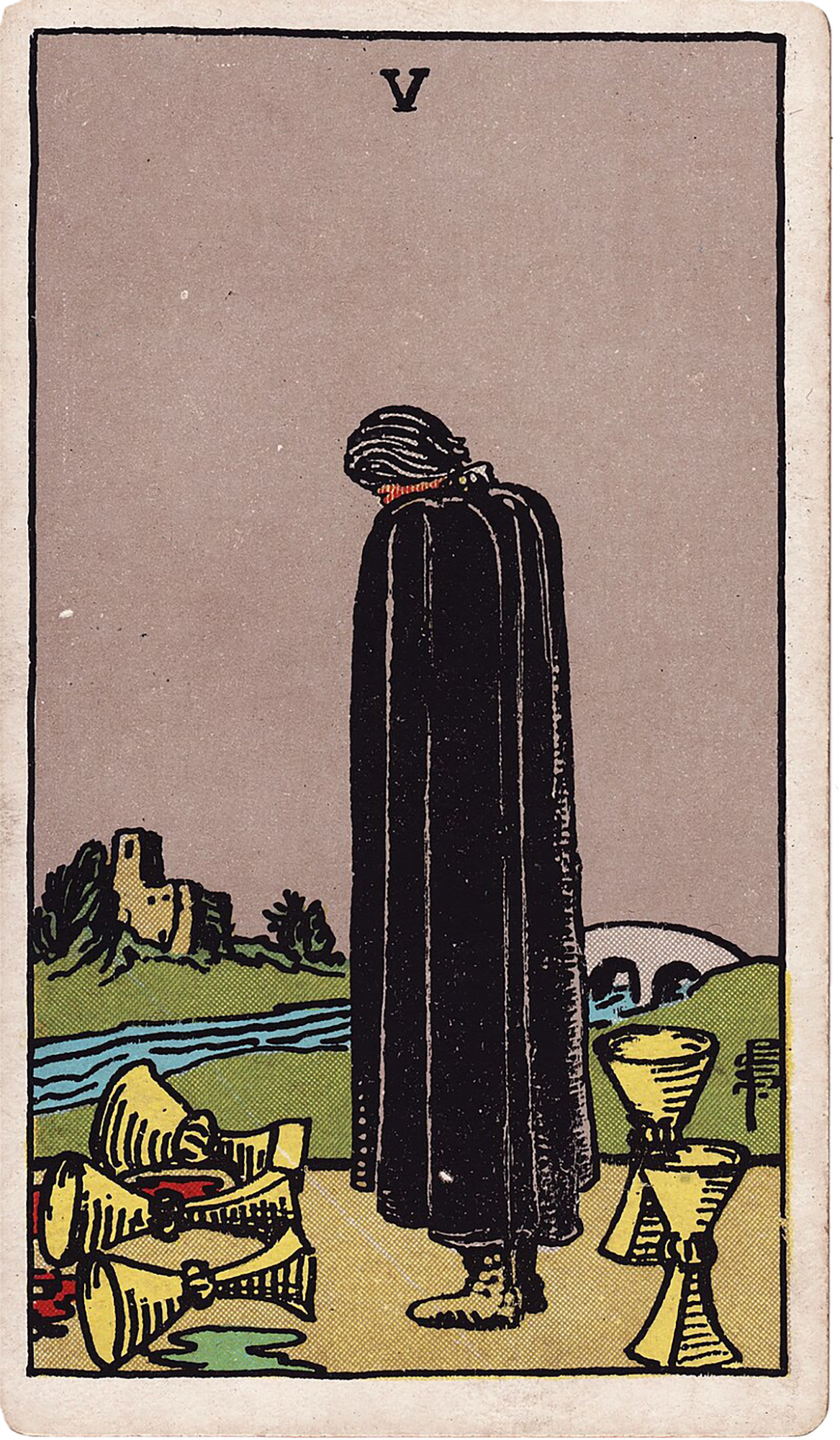 5 of Cups
Introduction: Why the 5 of Cups matters for grief and recovery
The supplied 5 of Cups (shown in the public images you will see with this article) is one of the Tarot's clearest cards about loss, disappointment, and the turning point between mourning and recovery. In both its upright and reversed positions the card focuses attention on how feelings are processed, what remains after loss, and the practical response required to begin rebuilding. This article is a single-card instructional lesson: we will use only the supplied 5 of Cups and its Rider–Waite–Smith imagery as the anchor for every interpretation. The goal is not fortune-telling but teaching a repeatable approach to interpreting this card when it appears in different contexts.
Reading the image: Rider–Waite–Smith symbolism in the supplied 5 of Cups
Start by studying the imagery on the supplied card. The classic Rider–Waite–Smith 5 of Cups shows a cloaked figure, head bowed, standing before three spilled cups while two cups remain upright behind them. A river runs past and a bridge leads to a distant structure (often a castle). Key symbolic elements to note and how they inform meaning: - The three spilled cups: obvious visible loss, disappointment, or regret. They represent emotions that have been expended or things that feel irretrievably gone. - The two upright cups behind the figure: resources or relationships that remain but are not yet recognized. They represent what endures, possibility, or consolation. - The cloaked, bowed figure: inward grief, focus on what’s lost, tendency toward rumination. The cloak suggests protective withdrawal and the difficulty of seeing clearly. - The river and bridge: movement and passage. The bridge points to a route forward — a crossing, transition or connection to healing — even if the figure does not yet take it. - The distant structure: a goal, community, safety, or the sheltering aspect of life that exists beyond immediate sorrow. When you interpret the supplied card, name these visual features aloud or mentally. Doing so anchors abstract definitions to visible clues and helps you give more concrete, practical readings.
Upright 5 of Cups: core meaning and practical prompt
Use the upright text supplied with the card as a baseline: "Upright, 5 of Cups highlights grief deserves acknowledgement, yet the full situation includes what remains; healing begins when loss and remaining resources can both be seen. The card is practical: it asks for a response that fits the present stage rather than an abstract ideal. Consider where this pattern is already visible and what action would strengthen its constructive side." Translate that into practice: the upright card often signals a stage of necessary mourning. The practical prompt is twofold — acknowledge loss, and inventory what still exists. The card does not demand denial of sorrow; rather it asks that grief be recognized while attention is also given to surviving supports and actionable next steps. In a reading this means: name what is lost, allow feeling, then ask "what remains?" and "what is a small, concrete next move?"
Upright meanings across contexts
Below are concise, context-specific ways to read the supplied upright 5 of Cups. These are teaching examples for learners rather than deterministic predictions. Love and relationships: The upright 5 of Cups often indicates heartbreak, a breakup, or disappointment in a relationship. Emphasize grieving what you’ve lost. Ask the querent to notice the two upright cups behind them — what supports (friends, memories that comfort, potential for reconciliation) still exist? The card can signal a healthy pause where sorrow is appropriate and repair might be possible if action focuses first on processing grief. Career and work: In a career context the card can point to a project failure, missed promotion, or workplace disappointment. The practical reading: acknowledge the setback, then map remaining assets — colleagues, transferable skills, or roles that remain possible. Use the bridge image: what small crossing (learning, networking) will help move from regret into movement? Money and finances: Financially, expect a temporary loss, bad investment, or an unexpected expense. The upright card asks the querent to grieve that loss briefly but to make an inventory of cash flows, reserves, and supports that remain. It favors a pragmatic plan rather than denial or escalation. Advice position: As advice the upright 5 of Cups tells you to allow yourself to mourn, but also to look behind you for what’s still full. It recommends a step-by-step approach: name the loss, set manageable rituals, and locate one practical resource to use today. Challenge position: As a challenge the card asks the querent to confront their sadness rather than avoid it. The obstacle is emotional focus on the past that prevents seizing available options. The work is to notice the two upright cups and move toward them. Person position: If representing a person, the upright 5 of Cups describes someone in mourning or withdrawal — often emotionally wounded, introspective, or temporarily unavailable. They are likely focused on loss but not permanently closed off. Outcome position: As an outcome the card suggests that grief will be part of the result but that recovery is possible if the lesson is attended to. The presence of a river and bridge implies eventual movement toward restoration. Spiritual reflection: The upright card invites a spiritual practice of lament and gratitude combined. It asks you to sit with sorrow, then deliberately find the two remaining cups and offer thanks for what remains as an act of reorientation.
Reversed 5 of Cups: core meaning and practical prompt
Use the supplied reversed text: "Reversed, 5 of Cups draws attention toward difficulty moving on, fixation on regret, suppressed grief or beginning to turn toward what is still available. The reversal may show too much of the card's usual energy, too little of it, or a situation where the lesson is understood intellectually but not yet lived consistently. It can also indicate that the issue is occurring internally and is not obvious to other people." Practically, the reversed card often means the grieving process is stuck in one of several ways: the person is stuck in rumination, prematurely forcing optimism, suppressing feelings, or has grasped the idea of moving on without doing the inner work. When you read the reversed 5 of Cups, ask: is the querent resisting grief, trapped in it, or trying to bypass it? The reading should point to one small concrete practice (ritual, talk, therapy, small material step) that addresses the specific blockage.
Reversed meanings across contexts
Love and relationships: Reversed, the 5 of Cups can mean you are refusing to let go or conversely that you are pretending you have already moved on. It can signal hidden grief — perhaps the partner is masking their feelings. Advice: look for signs of avoidance, encourage honest conversation, or recommend grief work before making big relationship decisions. Career and work: In work contexts the reversal can show prolonged resentment after a workplace setback or an attempt to bury disappointment by overworking. It can also mean you are beginning to see possibilities again but not acting on them. Encourage practical re-engagement or boundary work. Money and finances: The reversed 5 of Cups may point to ongoing anxiety about past losses, denial about financial reality, or a tentative beginning to rebuild. Practical steps include transparent budgeting, small secured choices, or consulting a trusted advisor rather than numbing. Advice position: As advice the reversed card asks you to notice one way you are stuck in regret: name it, and practice one concrete corrective — a ritual of release, a list of remaining resources, or a small act of restoration. Challenge position: The reversal as a challenge means the blockage is internal and perhaps not visible. The reader should probe for suppressed emotions or habitual avoidance that prevents healing. Person position: A person shown by the reversed 5 of Cups could be someone who appears composed but feels unsettled, or someone who clings to grievance. They might need encouragement to be seen or to seek help. Outcome position: The reversed outcome can go two ways: either slow persistence in grief or the start of a genuine turn toward recovery. The decisive element is the querent’s willingness to do the inward work. Spiritual reflection: Reversed, the card suggests shadow material — unprocessed sorrow or spiritual stagnation. Spiritual practice targeted at release and naming (journaling, confession, lament) will be helpful.
Technique: A step-by-step way to read the supplied 5 of Cups in a single-card spread
This is a repeatable technique for learners using only the supplied 5 of Cups card image. 1. Quiet observation (30–60 seconds): Look at the supplied card. Name out loud or mentally each visible element (spilled cups, two upright cups, cloaked figure, river, bridge, distant building). Anchoring words to imagery reduces projection. 2. Ask the core question: "Is this card upright or reversed in my reading?" Use the supplied upright and reversed descriptions precisely as templates for energy. 3. Identify which phase it indicates: Is this grieving that needs acknowledgment? Is it stuck grief? Use the lines from the supplied descriptions to classify: upright = acknowledgment + seeing remains; reversed = stuck, suppressed, or beginning to turn. 4. Contextualize: Place the card in the reading context (love, career, etc.). Use the context-specific cues above to translate symbols into concrete life elements (who or what are the spills, who are the two remaining supports, what is the bridge?). 5. Ask pragmatic follow-ups: "What exactly is being mourned?" "What are two specific things that remain?" "What is the smallest actionable step to move toward the bridge?" Use the answers to form advice. 6. Offer tempered guidance: Avoid sweeping promises. Recommend one or two concrete practices (rituals, lists, a phone call, a budget review, a therapy session) and set a time boundary (e.g., "Try this practice for one week and note differences"). 7. Close with integration: Summarize what was seen on the card, the practical steps, and how to monitor progress. If reversed and stuck, add a containment strategy (who to contact if overwhelmed). This method keeps readings concrete, emotionally honest, and actionable.
Examples: three short readings using the supplied card
Example 1 — Love, upright 5 of Cups: Querent recently ended a long relationship. You note the three spilled cups are the relationship, shared home, and joint plans; the two upright cups are close friends and their own capacity for affection. Advice: schedule a mourning ritual (write a letter never sent), then plan one small social contact this week to test emotional resources. Example 2 — Career, reversed 5 of Cups: Querent was passed over for promotion months ago and keeps replaying it. The reversed card suggests a stuck loop. Practical step: commit to one concrete career action that is not about the old job (update LinkedIn, informational interview) and one emotional step (weekly check-in with a counselor or trusted mentor). Example 3 — Money, upright 5 of Cups: Querent lost a significant investment. The card asks to acknowledge grief and inventory remaining assets. Practical step: list all liquid reserves and create a 30-day cash plan; pick one non-essential expense to pause and reassess in two months. Each example anchors interpretations to the imagery on the supplied card and translates symbolism into measurable actions.
Common mistakes when reading the 5 of Cups and how to avoid them
1. Treating the card only as doom: Learners often conflate the spilled cups with irredeemable fate. Avoid this by deliberately naming the two upright cups and asking what they are. 2. Ignoring timeline and nuance: The 5 of Cups is process-oriented. Don’t force immediate outcomes. Ask whether the card’s energy is beginning, developing, or stuck. 3. Over-pathologizing reversal: Reversed does not always mean "bader"; it signals blockage or internalized process. Pinpoint the type of blockage. 4. Giving abstract consolation: Saying "you’ll be fine" minimizes grief. Better to offer concrete rituals or steps. 5. Forgetting visual cues: Readers sometimes ignore the river and bridge. These elements are essential because they indicate a path and movement toward shelter. To avoid these mistakes, follow the step-by-step technique above and always ground interpretation in the card’s imagery and the querent’s real-world situation.
Integrating the 5 of Cups into multi-card reading practice and follow-up work
Even in a single-card teaching context, knowing how the 5 of Cups functions inside larger readings is useful. If you later add cards, use the 5 of Cups as the emotional center and ask how other cards clarify the spilled cups, identify the two remaining cups, or map the bridge. For follow-up work after a reading with the 5 of Cups, recommend: - A grief practice: journaling, ritual writing, art-making or a private ceremony. - A concrete inventory: list resources, friends, finances, and skills that correspond to the two remaining cups. - One small external step: a phone call, task, application, or appointment that enacts movement toward the bridge. Set a check-in for 1–3 weeks to reassess whether the card’s energy has shifted from mourning to rebuilding.
Exercises and practice prompts
1. Visual naming exercise: Spend one minute looking at the supplied card and name each element out loud. Then write one sentence linking each element to your own life. 2. Two-cup inventory: For a personal situation, list three things you are grieving, then list two concrete resources that still exist. Plan one specific action that uses one of those resources within 72 hours. 3. Reversal mapping: If you pull the reversed 5 of Cups for yourself, write down whether you are avoiding, ruminating, or pretending to have moved on. For each option, list one change to try this week (therapy session, timed rumination practice, or an honest conversation). 4. Reading lab: Practice three single-card readings for different people (friend, co-worker, yourself), using only the supplied 5 of Cups and the step-by-step technique. Note differences in language and specificity.
Conclusion: Holding grief and possibility together
The supplied 5 of Cups is a compassionate card: it authorizes grief and points to what remains. Your job as a reader is to refuse both cheap optimism and paralyzing doom. Use the Rider–Waite–Smith imagery on the supplied card — spilled cups, two upright cups, cloaked figure, river, bridge, distant shelter — as tangible anchors. Translate those images into concrete, small steps appropriate to the querent’s context. Whether upright or reversed, the card asks for honest acknowledgment of loss and a pragmatic path forward. Teach your querents to mourn well and to look back for what still holds.
Practice questions
• What in the supplied 5 of Cups image most resonates with a loss you have experienced recently?
• When you focus on the two upright cups behind the figure, what resources or relationships come to mind?
• Do you tend to avoid grief, stay stuck in it, or rush toward closure? How does the reversed 5 of Cups describe your pattern?
• What is one small, concrete step you could take this week that uses an existing resource (one of the upright cups)?
• How can you translate the bridge on the card into a real-life plan for transition or connection?
• In what ways might grief be happening internally and not visible to others in your life?
• What ritual or practice would help you acknowledge a loss without letting it define you entirely?
• How will you check progress in one to three weeks after practicing the steps suggested by this card?
Comments
Sign in to comment.
Continue learning
Harnessing the Power of The Magician and Ace of Wands: Igniting Creativity and Manifestation in Tarot Readings
The combination of The Magician and the Ace of Wands in tarot readings offers a potent blend of creative energy and manifestation power. This article delves into the ways these car...
Developing Intuitive Tarot Reading Skills with The High Priestess and The Moon
This article guides tarot learners through developing intuitive reading skills focusing on two powerful cards: The High Priestess and The Moon. Using traditional Rider-Waite-Smith...
Using the Relationship Five Card Spread to Identify and Heal Emotional Blocks
This article offers an in-depth guide to the Relationship Five Card Spread, a practical Tarot layout designed to illuminate emotional blocks within relationships and suggest paths...
Exploring the Symbolism of the Four Suits in Tarot for Deeper Reading Insights
This article explores the symbolism embedded in the Four Suits of the Tarot deck—Wands, Cups, Swords, and Pentacles—by closely examining the Ace cards from each suit. By analyzing...
Mastering the Art of Three Card Spread for Daily Insight and Decision Making
The three card spread is a versatile and accessible Tarot technique ideal for daily insight and aiding decision making. This article breaks down the method step-by-step, linking th...
Using the Five Card Cross Spread to Identify and Overcome Emotional Blocks in Relationships
The Five Card Cross spread is a practical and insightful tool to explore emotional blocks in relationships. By placing cards in positions representing Present, Past, Future, Challe...
Mastering Intuitive Tarot Reading Techniques for Beginners and Advanced Learners
This article guides both beginners and advanced tarot readers in mastering intuitive reading techniques by focusing on The High Priestess, The Hermit, and The Moon cards. It highli...
Mastering Intuitive and Analytical Tarot Reading Techniques for All Levels
This article guides tarot learners through mastering both intuitive and analytical reading techniques by closely examining three powerful cards from the Rider-Waite-Smith tradition...
Mastering Intuitive and Analytical Techniques for Effective Tarot Reading
This article guides readers through mastering both intuitive and analytical techniques to improve tarot reading effectiveness. By engaging deeply with the symbolism and traditional...
Uncovering the Origins and Enduring Mysteries of the Wheel of Fortune Card in Tarot History
The Wheel of Fortune is one of the most enigmatic and symbolically rich cards in the tarot deck, embodying the cyclical nature of life, fate, and change. This article explores the...