
Judgement Card Meanings Across Love Work and Inner Calling
This article is a close, practical study of the Judgement card as a single-card lesson. Using the supplied Judgement card image and the provided upright and reversed descriptions, the article teaches learners how to translate the card's Rider-Waite-Smith imagery and symbolic themes into nuanced interpretations for love, work, finances, advice, personal character, outcomes, and spiritual reflection. You will find step-by-step reading technique, concrete example readings, common mistakes to avoid, and journaling prompts that make the card useful as guidance rather than prophecy. The emphasis throughout is on discerning which aspect of the card's central lesson—honest review, a call to change, deliberate choice, or self-judgment—is active in the querent's situation.
Cards explored in this article
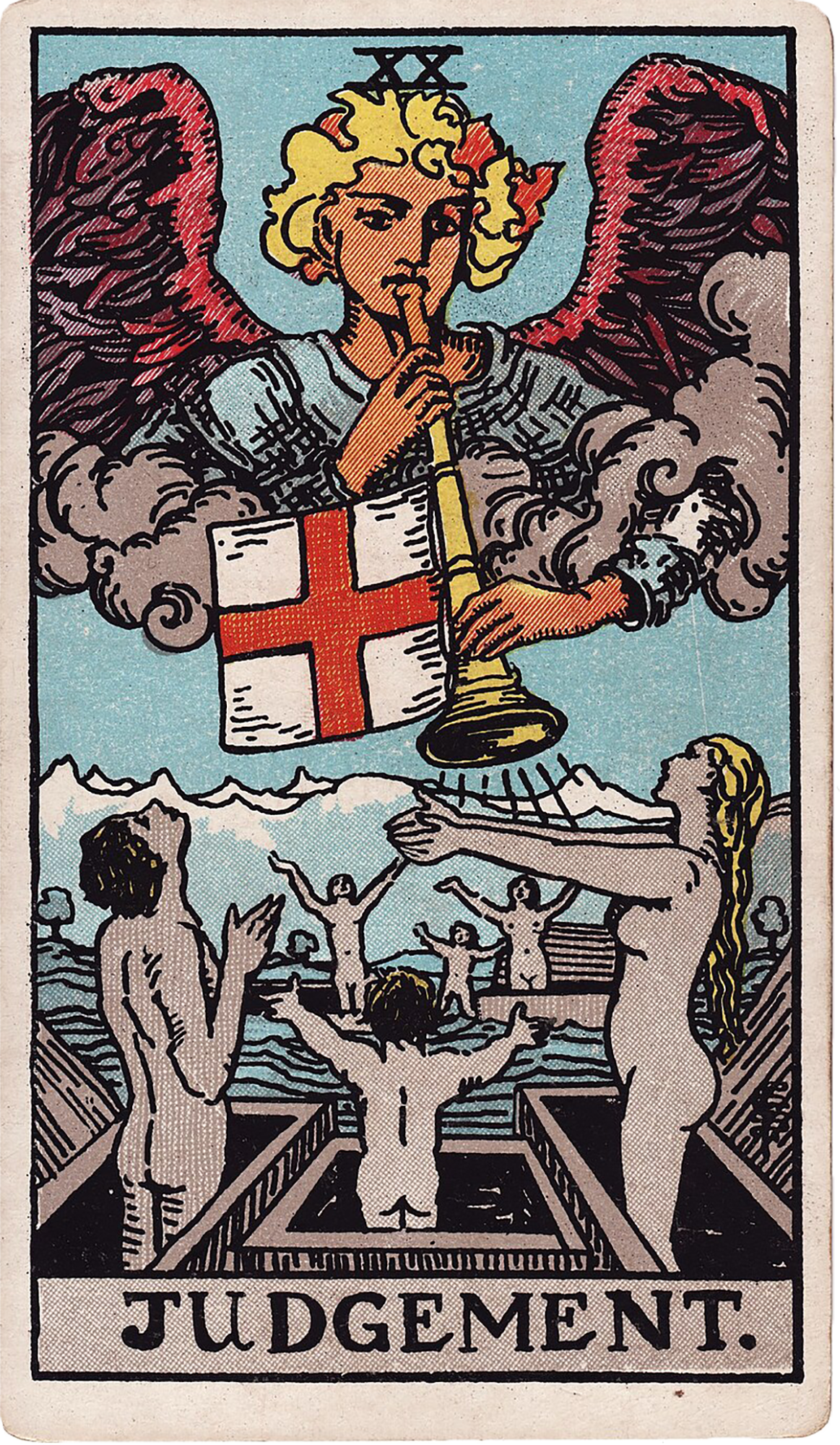 Judgement
Introduction and Core Description
This lesson examines the single card Judgement as presented in the supplied image and the accompanying descriptive text. Refer to the supplied Judgement card image as you read. The provided upright text summarizes the card's primary tone: "Upright, Judgement emphasizes reviewing the past honestly, answering a call to change, and making a decision from a more integrated understanding. This does not mean the situation will automatically become easy. Instead, the card describes the quality that can be used constructively. When this card appears, ask where a direct response, clearer boundary, deeper honesty, or more deliberate choice would move the situation forward. On a practical level, the upright card encourages the reader to work with what is available now. It can indicate that the central issue has become visible enough to engage consciously. Rather than waiting for certainty, use the symbolism to identify the next proportionate step and notice which part of the card's lesson is already present in your behavior." The provided reversed text reads: "Reversed, Judgement often turns attention toward self-judgment, avoidance of accountability, fear of change, or repeatedly revisiting the past without acting on what has been learned. A reversed card is not automatically 'bad'; it may show that the upright quality is blocked, delayed, internalized, exaggerated, or being expressed without balance. The useful question is not 'what disaster does this mean?' but 'where is this energy becoming distorted or difficult to access?' In some readings, reversal can indicate that the issue is becoming more private and psychological. It may also mark a correction: the person is beginning to see an old pattern but has not yet fully changed it. Look to neighboring cards for evidence of whether the reversal describes resistance, recovery, excess, or a temporary pause." Keep this supplied language in front of you: the upright emphasizes an outward, decisive call and practical next step; the reversed points to internal distortions, avoidance, or incomplete transition.
Imagery to Anchor Interpretation
Anchor every interpretation to the visual details of the supplied Judgement card image. In the Rider-Waite-Smith tradition this card shows an angel—often identified with Gabriel—blowing a trumpet whose banner carries a red cross, while naked figures rise from coffins, arms open toward the sound. A mountain sits in the background and water is present in the foreground or middle ground. Two key symbolic sets to note: the trumpet/angel as a call, external summons, or announcement; and the rising figures and coffins as resurrection, rebirth, and exposure. The red cross on the white banner connects to themes of service, healing, or conscience. The nakedness of the figures represents vulnerability and honesty; nothing is hidden. The mountain suggests the long-term context or obstacle that remains beyond immediate awakening. In practice, stretch these images into specific questions: Who or what is sounding the trumpet in this situation? What is being asked to rise and be seen? Which part of the querent's life feels like a coffin or concealment ready to be opened? Always start with what you can see on the card image and the feelings it produces, then bring in the supplied upright/reversed descriptions as a second layer.
Reading Strategy: How to Interpret a Single Judgement Card
A single-card reading with Judgement must answer two tasks: identify which judicial energy is present (call to change, honest review, or self-condemnation) and translate that energy into a context-specific next step. Use this four-step method each time: 1) Observe: Note the angel, trumpet, rising figures, banner, and landscape. Record immediate impressions and bodily reactions. 2) Place the supplied text: Decide whether the upright passage or the reversed passage better matches your initial emotional response and the practical situation being asked about. 3) Ask context questions: Based on whether you are reading love, work, money, or spirit, ask a small set of targeted questions (examples provided below). 4) Recommend a proportionate next action: If upright, suggest a concrete, possible first step that reflects honesty, clear boundary, or a deliberate choice. If reversed, suggest an inward corrective work such as naming the self-criticism, making a private accountability plan, or delaying a public move until the pattern is integrated. Keep notes on how the image and supplied text overlap; this is your evidence when you explain the card to a querent.
Upright Meanings Across Contexts
Use the supplied upright description as the central rubric: honest review, answering a call to change, and making decisions from an integrated understanding. Below are context-specific translations anchored to the card image. Love (single): The trumpet can represent an invitation—sudden clarity that a certain type of partner or relationship pattern must change. The rising figures suggest leaving old emotional 'coffins' such as previous heartbreak, shame, or hidden expectations. Practical reading: encourage a conscious review of past relationship patterns. Ask: "What lesson from previous partnerships is this call making louder?" Suggest a proportionate step like drafting a short list of nonnegotiables and a small practice of saying one honest thing in a dating context. Love (in partnership): Here Judgement often signals a time for an honest conversation, a boundary reset, or mutual accountability. The angel's trumpet can be a shared wake-up call—perhaps a shared value mismatch or the need to decide about next steps. Practical reading: recommend a focused conversation using 'I' statements and a single question: "Given what we've learned, what is the smallest next step that respects both of us?" Career/Work: Upright, the card can announce a turning point—recognition, a new role, or the need to change direction after assessing past decisions. The angel can represent an external call: a job offer, a promotion, a request to lead, or the market signaling something is no longer working. Practical reading: identify the next smallest career choice that aligns with your integrated lessons—update CV, volunteer for a visible project, or request a performance review. Money/Finances: Judgement upright asks for reviewing financial past honestly—debts, bad assumptions, or spending patterns—and acting deliberately now. The trumpet can signal that conditions have become clear enough for budgeting or restructuring. Practical reading: suggest a transparent budget review, speak to a financial advisor, or create a repayment plan that starts with one concrete payment. Advice: As advice, the card says answer the call—be auditable and accountable. It advises directness, a clarified boundary, or making a considered choice instead of passive waiting. Challenge: Upright indicates the challenge is to align past lessons with present action. The test is not whether you feel ready but whether you can act from integrated learning. Person: If representing a person, upright Judgement often describes someone who is catalyzing change—an honest leader, an advocate for accountability, or someone urging you to reconcile. Outcome: Upright, the outcome is a decision point or a partial rebirth; it signals movement and visibility rather than guaranteed ease. Spiritual reflection: Upright calls for spiritual honesty—confessing patterns, choosing a path that integrates belief with practice, and responding to a felt vocation. Across all contexts anchor these meanings to the image: the angel invites, the figures rise, and the landscape suggests longer-term work remains.
Reversed Meanings Across Contexts
Use the supplied reversed description: attention turned to self-judgment, avoidance, fear of change, or revisiting the past without action. Love (single): Reversed, the trumpet may be muffled—you hear past heartbreak but are stuck in self-reprimand or doubt, repeating choices that keep you from meeting new people. The nakedness now feels exposed in a shameful way rather than freeing. Practical reading: address self-critical narratives first; practice one compassionate reframe and set a tiny social goal. Love (in partnership): The reversed card can show avoidance—one partner blames the other or both rehash old grievances without resolving them. It may also mean shame prevents honest talk. Practical reading: advise mediated conversation or a pause to journal grievances into a private list to avoid re-triggering cycles. Career/Work: Reversed, Judgement can appear as fear of accountability—avoiding necessary upskilling or repeating the same ineffective tactics. The trumpet is an inner alarm you ignore. Practical reading: recommend audit of skills, small steps to remove avoidance (schedule one learning session), or seek feedback rather than internalizing boss criticisms as identity. Money/Finances: Reversed indicates either denial about debt patterns or harsh self-punishment for past financial mistakes. It may also mean circular planning without implementation. Practical reading: create one measurable corrective action (e.g., automate a small savings transfer) and track it to counteract paralysis. Advice: The card cautions against rushed public declarations or excessive self-condemnation. The correct advice may be to slow down and do inner work or to reframe accountability into supportive systems. Challenge: The challenge is internal: shame, judgment, and repeating old habits. Person: If representing a person, reversed Judgement might describe someone critical, defensive, or in denial about their role. Outcome: Reversed, the outcome suggests incomplete transition—insight without action or a delayed correction. Spiritual reflection: Reversed often indicates a private, psychological phase: wrestling with guilt or spiritual exile rather than an outward calling. Throughout, read the image as restricted: the trumpet may still be present but its sound feels blocked, and the rising figures may hesitate. Interpret the blockage concretely and suggest an initial small, safe corrective action.
Practical Reading Method and Sample Questions
When the supplied Judgement card appears alone, use the following practical method to turn symbolic insight into useful guidance. Step 1 — Naming: Quietly name the prominent image elements: "angel/trumpet, red cross banner, naked figures, coffins, mountain." Step 2 — Match supplied text: Note whether the upright or reversed supplied passage maps onto your initial visceral impression. Step 3 — Contextualize: Ask 3 context-specific diagnostic questions. Examples: Love (single): "What exact pattern from past relationships keeps resurfacing?" Love (partnership): "What must we honestly name to choose a next step together?" Career: "What evidence suggests this is a turning point rather than a temporary upset?" Money: "Which repeating financial habit is hiding in the dark?" Spiritual: "What inner voice is calling me to change, and what would a small act of obedience look like?" Step 4 — Proportionate action: Suggest one immediate, proportional action: one sentence, one call, one appointment, one small payment, one honest sentence to a partner. Step 5 — Accountability: If upright, encourage a public or shared accountability step. If reversed, suggest private corrective work before public moves. Step 6 — Follow-up: Schedule a check-in—two weeks is a useful short window to notice movement or further resistance. Use language anchored to the image when presenting to a querent: "The trumpet asks for one clear sentence you can speak about this issue."
Examples and Mini Case Studies
Example 1 — Single person seeking love (Upright): Maria draws the supplied Judgement card upright. She sees the angel and the rising figures and feels a sense of clarity. Apply method: name imagery, match upright text (call to change), ask: "What pattern must I stop repeating?" Maria identifies that she has settled for emotionally unavailable partners. Proportionate action: she drafts a single dating boundary and sends a clear message in her next two conversations. Outcome logic: the card signals visibility and that acting from learned lessons will change options. Example 2 — Long-term partnership stuck in blame (Reversed): John draws Judgement reversed. He feels the trumpet is muffled. Apply method: match reversed text (self-judgment and avoidance). Diagnostic question: "How am I using criticism to avoid talking about what I actually need?" Action: John commits to one compassionate journal entry and suggests a neutral mediator for the next difficult talk rather than launching into blame. Example 3 — Career crossroads (Upright): A manager sees the card upright when deciding whether to switch fields. The angel is an external call: a recruiter reached out. The card suggests reviewing past choices and choosing deliberately. Action: set up one informational interview and write a one-paragraph personal mission statement to test alignment. Example 4 — Money and debt (Reversed): A client draws Judgement reversed while stressed about repeated late payments. The reversed card highlights shame and avoidance. Action: create an automatic transfer of a small repayment amount and schedule a fifteen-minute call with an advisor—small, manageable steps to counteract paralysis. Example 5 — Spiritual calling (Upright): The querent senses a vocational pull. Judgement upright suggests that this is a genuine call, not fantasy—start by naming the smallest skill or practice that aligns with the call and test it for two weeks.
Interpretation Logic and Teaching Points
Teaching students to interpret Judgement requires clear translation rules. Rule 1 — Call versus Condemnation: Distinguish whether the 'sound' is inviting a constructive change or triggering self-condemnation. Use the supplied upright/reversed descriptions as your diagnostic scaffold. Rule 2 — Visibility and Proportion: Judgement makes issues visible. That does not imply all problems are solved; it implies the next action should be proportionate to the new clarity. Rule 3 — Public versus Private: Upright leans outward—public decisions, accountability, clear announcements. Reversed leans inward—private psychological work or delayed public action. Rule 4 — Evidence-based reading: Anchor claims to the image and the supplied text. For example, if you claim the card signals reconciliation, point to the rising figures and the banner as symbols of restored life and service; if claiming a pause, reference the reversed description about delay. Rule 5 — Avoid moralizing: Judgement’s language can be religious; teach students to translate it into pragmatic ethical language: accountability, responsibility, and honest appraisal—not divine punishment.
Common Mistakes and How to Avoid Them
Mistake 1 — Treating Judgement as automatic reward or punishment. Correction: The card signals a dynamic, not a guaranteed result. Emphasize proportionate action. Mistake 2 — Over-spiritualizing the image. Correction: Use religious symbolism as metaphor for processes of change and accountability; translate into observable behaviors. Mistake 3 — Ignoring reversal nuance. Correction: Reversed Judgement is not only "bad luck"—it often marks internal work beginning or a temporary pause. Mistake 4 — Forcing timing predictions. Correction: Judgement indicates readiness to act, not precise timing. Avoid rigid timelines unless supported by broader spread context or timing techniques. Mistake 5 — Skipping concrete steps. Correction: Always pair insight with one small, measurable next action. This helps prevent readings from remaining purely abstract. Mistake 6 — Not checking the querent's readiness. Correction: The trumpet may be heard by the reader but not by the querent. Ask whether they feel ready to act and tailor suggestions accordingly.
Integrating Judgement into Practice and Study
For learners, working with the supplied Judgement image is best done through repeated small exercises. Exercise 1 — Daily one-line journal: For a week, draw the image in your notebook and write one sentence about what the trumpet might be calling for in your day. Exercise 2 — Role-play: Practice reading Judgement for a partner in each of the contexts above, focusing on using the supplied upright/reversed phrases verbatim to anchor your interpretation. Exercise 3 — Action pairing: For every reading where Judgement appears, require one follow-up appointment or check-in. This trains you to convert symbolic insight into accountability. Exercise 4 — Imagery mapping: Annotate a printed copy of the supplied Judgement card with keywords attached to each visual element (trumpet=call, figures=rebirth, banner=service, mountain=work remaining). Use these annotations when you slow-read the card in subsequent readings. Over time you will learn to see whether the card leans more toward public announcement or private correction and to recommend steps that are safe, practical, and proportionate.
Closing: Teaching Ethic and Student Checklist
When teaching Judgement as a single-card lesson, emphasize ethics: readings should empower choice, not coerce action. Before concluding a reading, run the student checklist: 1) Did I anchor my interpretation to the supplied image details? 2) Did I reference the supplied upright or reversed description accurately? 3) Did I ask at least one context-specific diagnostic question? 4) Did I propose a single proportionate action the querent can take within one week? 5) Did I avoid moralizing language and instead frame accountability as practical next steps? If yes to all, the reading is pedagogically sound and practically useful. The supplied Judgement card offers a powerful lens to teach responsibility, clarity, and courageous small steps; used carefully it becomes a tool for transformation rather than a verdict.
Practice questions
• When you look at the supplied Judgement card image, which element—trumpet, rising figures, banner, mountain—catches your attention first, and why?
• Which part of the supplied upright description feels most relevant to your current life: honest review, answer to a call, or deliberate choice?
• If the card appears reversed for you, what inner judgment or avoidance are you most likely to be repeating?
• What is one proportionate action you could take in the next week that aligns with the Judgement card's lesson in your chosen context (love, work, money, or spirit)?
• Who would be a safe person or structure for accountability if you chose to act on this card's message?
• How might religious or cultural images in the Judgement card affect your reading, and how can you translate those images into neutral, behavioral advice?
• When you hear the 'trumpet' of this card, is that an external opportunity or an inner demand, and how do you tell the difference?
• What would evidence of integration look like in three months if you acted on Judgement's guidance now?
Comments
Sign in to comment.
Continue learning
Interpreting the Dance of Justice and The Devil: Balancing Morality and Temptation in Tarot Readings
The combination of Justice and The Devil in tarot presents a profound exploration of morality, temptation, and personal accountability. This article unpacks how these cards influen...
Understanding The Justice Card in Legal Career and Ethical Life Decisions
The Justice card in Tarot serves as a powerful symbol of fairness, accountability, and ethical clarity. This article explores the card’s upright and reversed meanings specifically...
Exploring The Justice Card in Ethical Decision Making and Personal Integrity
The Justice card in the Tarot deck is a profound symbol of fairness, truth, and accountability. This article explores how to interpret Justice in various contexts such as love, car...
Understanding The Justice Card in Ethical Decision Making and Personal Accountability
The Justice card in Tarot symbolizes fairness, truth, and accountability, emphasizing clear-eyed decision making and ethical responsibility. This article explores how Justice’s upr...
Understanding The Justice Card in Legal Ethical and Personal Decision Making
The Justice card in Tarot embodies fairness, truth, and accountability, serving as a powerful symbol for balanced decision-making. This article explores its upright and reversed me...
Understanding The Justice Card in Ethical Choices Legal Matters and Personal Accountability
The Justice card in Tarot symbolizes fairness, truth, and the ethical weighing of facts. In upright position, it urges clear-headed decisions, acceptance of consequences, and delib...
Understanding The Justice Card in Ethical Decision Making and Everyday Life
This article offers a comprehensive exploration of the Justice card from the Tarot deck, focusing on its significance in ethical decision making and everyday life situations. Using...
Understanding The Justice Card in Conflict Resolution and Ethical Decision Making
The Justice card in Tarot symbolizes fairness, truth, and accountability, making it a powerful tool for navigating conflicts and ethical dilemmas. This article explores its upright...
Exploring The Justice Card for Fairness Responsibility and Ethical Life Choices
The Justice card embodies fairness, responsibility, and ethical living through clear-eyed decision-making and accountability. This article explores how the Justice card's upright a...
Understanding the Many Facets of the Justice Card in Everyday Decision Making
The Justice card is a powerful symbol of fairness, accountability, and clarity in decision making. This article explores how the card's upright and reversed meanings adapt to multi...