
Interpreting the Page of Swords for Career Love and Personal Growth
This article teaches how to read the supplied Page of Swords single-card draw across multiple life contexts. Using the card's Rider-Waite-Smith imagery and the provided upright and reversed definitions, you will learn to observe, ask clarifying questions, and translate the card's mental curiosity and vigilance into actionable guidance for career, love, money, personal challenges, and spiritual growth. Includes techniques, examples, common mistakes, and practice methods for confident interpretation.
Cards explored in this article
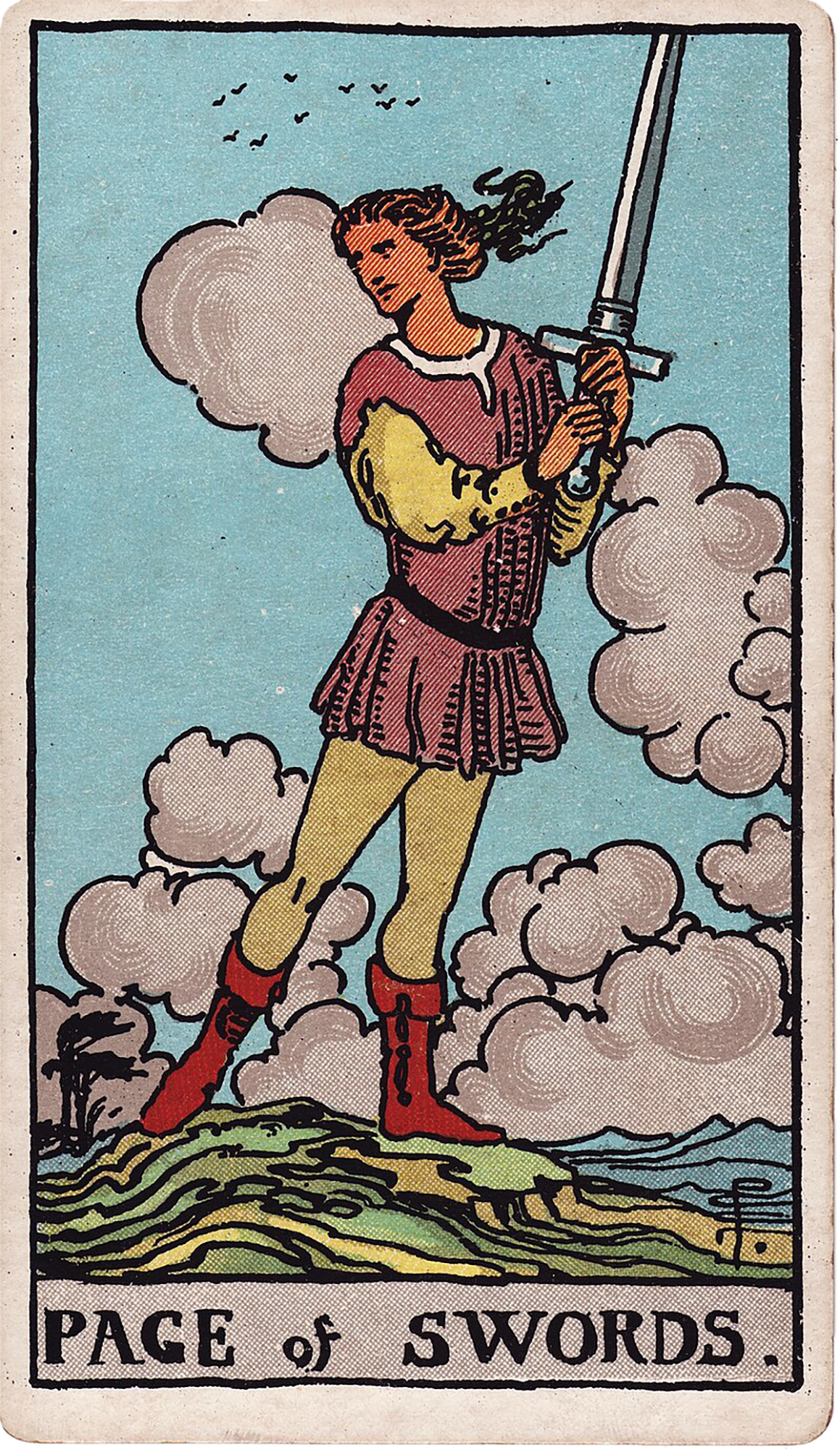 Page of Swords
Introduction to the supplied Page of Swords
This lesson centers on the supplied Page of Swords card. The card's upright text emphasizes mental curiosity, vigilance, and a desire to ask questions or gather information; the reversed text highlights gossip, defensiveness, scattered attention, and speaking before understanding. Throughout this article we will repeatedly connect interpretation to the card's imagery: the youthful figure holding a raised sword against a windy sky, the alert posture, the movement in the clothing and clouds. These visual details are the starting point for every contextual read. Remember: this material is for learning and skill development, not guaranteed prediction.
Rider-Waite-Smith symbolism to note
The Rider-Waite-Smith imagery of the Page of Swords offers clear signals for interpretation. Key elements to anchor to the supplied card are: the young figure or 'page' suggesting inexperience, study, or a fresh phase of learning; the upright sword held ready, pointing to intellect, communication, and readiness to engage mentally; the windswept hair and tunic and moving clouds, signaling restless energy, changeable ideas, curiosity, and the need for adaptability; the open landscape with distant hills, implying broad possibilities and observation rather than immersion. When you look at the supplied Page of Swords card, read each of these elements as verbs, not nouns: the card shows a mind in motion, not a settled conclusion. The Swords suit is the air element, so priority goes to thought patterns, conversation, evidence, and how ideas move through the situation.
How upright and reversed meanings differ in practice
Use the provided upright description as a practical guide: the situation can be managed through mental skills — asking questions, gathering data, planning, and clear communication. The upright Page often signals beginnings: a new line of inquiry, a request to be vigilant, or a childlike eagerness to learn. The supplied reversed description is not simply 'bad.' It asks you to look for where the Page process is stuck: gossip, defensiveness, scattered attention, or premature conclusions. In practice, treat reversed as an internal or social blockage: the energy exists but is distorted. Ask whether the querent has information but is misusing it, or whether excessive restlessness prevents follow-through. Always map back to the card image: is the figure's sword steady or wavering in your mind's eye? That visual sense helps you decide whether the card feels upright, reversed, or a mix.
Practical reading method for a single-card draw
Step 1 — Observe: Spend at least 30 seconds looking at the supplied Page of Swords card. Note posture, sword angle, clothing, sky, and direction of gaze. Describe these out loud or in your journal. Step 2 — Keywords: Assign 3–5 keywords from the upright/reversed text that most resonate — for example, curiosity, vigilance, questions, scattered attention. Step 3 — Context prompt: Ask the clear contextual question you were hired to answer (love, career, money, etc.). Step 4 — Ask clarifiers: Is this card announcing the beginning of an inquiry, warning of gossip, proposing a role to take, or naming a habit to change? Step 5 — Synthesize: Turn observation and keywords into guidance. Focus on action verbs — investigate, ask, monitor, simplify, practice listening. Step 6 — Offer a next-step: Give a concrete small action the querent can do in the next 48–72 hours (ask three clarifying questions, write down assumptions, pause before replying during a heated exchange). This method anchors interpretation to the supplied imagery and the provided upright/reversed definitions.
Interpreting the supplied Page of Swords in career
Upright career reading: The supplied Page of Swords suggests a time to gather intelligence, ask questions, and test ideas. The figure's raised sword signals readiness to debate or present a proposal; the windswept clothing points to rapid change or new information arriving. For a job-searcher or someone starting a project, the card recommends curiosity-driven research, informational interviews, and drafting a clear argument for your value. Practical advice: compile facts and prepare to defend your ideas with evidence rather than emotion. Example: If you draw the supplied Page of Swords when wondering whether to propose a new team process, take it as permission to pilot a small test and solicit feedback rather than launching everything at once. Reversed career reading: The supplied reversed Page of Swords highlights gossip, unclear priorities, or miscommunication at work. Perhaps someone is speaking before understanding or rumors are steering decisions. The image of the Page in a windy landscape can flip into scattered attention: too many initiatives without completion. Practical advice: pause on public statements, document your communications, and seek a trusted colleague to verify facts before acting. Example: If you are considering a promotion, the reversed card may mean your reputation needs repair; focus on clarifying misunderstandings and finishing obligations.
Interpreting the supplied Page of Swords in love and relationships
Upright love reading: In relationships, the supplied Page of Swords invites questions and curious conversation. Read the Page as an encouragement to open intellectual channels: ask about values, plans, and boundaries. The youthful quality invites playful curiosity — a date that involves discussion, games of ideas, or exploring each other's perspectives. If single, the card can indicate messages, flirtatious banter, or the start of a relationship that will be idea-driven. Practical action: practice active listening and prepare three thoughtful questions to deepen connection. Reversed love reading: The supplied reversed Page of Swords warns of gossip, misinterpretation, or arguing without fully listening. The Page's sword becomes a weapon when words are used to wound or to spy through social media. Practical advice: resist public airing — take conflicts offline; check assumptions before confronting; set a intention to listen twice as much as you speak. Example: If a partner's text tone triggers you, the reversed card suggests pausing before replying and writing out what you feel to gain clarity.
Interpreting the supplied Page of Swords for money and practical resources
Upright money reading: Financially, the supplied Page of Swords asks you to investigate, compare offers, and gather facts. The Page may signal the start of learning about budgets, taxes, or contracts. Treat the sword as a tool: sharpen information to make better choices. Action step: research at least three sources before committing funds; ask clarifying questions to any advisor. Reversed money reading: The reversed card points to impulsive spending based on hearsay, scams, or scattered financial priorities. It can also mean anxiety-driven micromanagement that prevents deeper planning. Recommendation: simplify — create a single, clear budget rule and block time for financial review so attention is not dissipated by noise. Use the supplied imagery to remind yourself that wind and motion without a steady hand lead to messiness; steady the sword by reducing distractions.
Interpreting the supplied Page of Swords as advice and as a challenge
Advice reading (upright): The supplied Page of Swords recommends asking questions, doing reconnaissance, and communicating with clarity. It encourages curiosity and a willingness to admit you are learning. Suggested immediate practice: write down three assumptions you have about the situation and then draft three questions to test them. Challenge reading (reversed): The supplied reversed Page of Swords names the obstacle: talk before understanding, defensiveness, or scattered focus. The challenge may appear internal — a habit of quick judgments — or external — gossip or misinformation. To work with the challenge, simplify and practice pausing. A concrete technique: use the 'two breaths' rule — take two full breaths before replying to a provoking message — to create space between impulse and speech.
Interpreting the supplied Page of Swords as a person or personality
When the supplied Page of Swords represents a person, read them as intellectually curious, talkative, observant, and sometimes restless. They might be younger or youthful in manner; they may be a student, intern, junior colleague, or the person who asks many questions in meetings. Upright: this person is energetic, eager to learn, and willing to speak up. Reversed: they may be meddlesome, prone to gossip, defensive, or inconsistent — someone who jumps to conclusions without full data. In readings where the querent asks 'Who is this person?' place emphasis on posture in the supplied image: is the Page forward-leaning and engaged (upright) or nervy and darting (reversed)? That physical sense helps you determine social style and likely behaviors.
Interpreting the supplied Page of Swords as an outcome and in spiritual reflection
Outcome reading (upright): As an outcome, the supplied Page of Swords indicates an emerging clarity obtained through inquiry. The result will not be a completed project but a new understanding or message that reorients action. Expect news, a test, or a conversation that catalyzes further steps. Outcome reading (reversed): The outcome may be muddled by misunderstanding, gossip, or premature action. It warns that the situation may require more time to settle and asks for corrective communication and restraint. Spiritual reflection: The supplied Page of Swords invites you to examine mental habits and the ethics of speech. The winds in the image call attention to the transient nature of thoughts; the sword asks for honest investigation. Upright spiritual practice: cultivate deliberate study, journaling, and mindful questioning — 'What am I assuming?' Reversed spiritual work: notice inner chatter, the temptation to judge quickly, and the habit of repeating rumors to feel informed. Practice silence, discernment, and disciplined listening to reduce harm and increase spiritual clarity.
Examples of readings tying technique to contexts
Example 1 — Career upright single-card read: Querent draws the supplied Page of Swords about whether to launch a talk at work. Observation: Page looks ready and vigilant. Guidance: Pilot a short test talk, solicit feedback, and prepare to field questions. Next step: schedule a 15-minute lunch presentation and ask for three pieces of feedback. Example 2 — Love reversed single-card read: Querent worried about partner's social posts draws the supplied reversed Page of Swords. Observation: imagine the Page's restlessness turned to prying. Guidance: avoid public accusations; ask clarifying questions in private; request a pause before escalating. Next step: write a neutral message asking for time to talk. Example 3 — Money upright single-card read: Querent evaluating a contract draws the supplied Page of Swords. Observation: sword as tool for scrutiny. Guidance: read contract clauses and prepare questions for a lawyer. Next step: identify three clauses that need clarification before signing.
Common mistakes learners make with the supplied Page of Swords and how to avoid them
Mistake 1 — Reading the Page as only trouble when reversed: The reversed supplied Page of Swords is a diagnostic tool, not an omen. Ask what is stuck and how to simplify. Mistake 2 — Ignoring the image and relying only on keywords: The Rider-Waite-Smith visual cues (posture, wind, sword) tell you whether the energy is active, passive, or scattered; always describe what you see first. Mistake 3 — Forcing predictiveness instead of process: The Page is frequently about beginnings and processes; avoid promising final outcomes. Mistake 4 — Confusing court cards: Don't substitute characteristics of other court ranks; the Page emphasizes learning and curiosity more than authority or refinement. Mistake 5 — Neglecting context: A single-card reading must be tied to a clear question. Use the practical reading method in this article to avoid vagueness.
Practice exercises and a simple rubric for graders
Exercise 1 — Observation drill: Spend two minutes with the supplied Page of Swords and write five sentences describing physical details without interpretation. Then write five sentences interpreting those details in a career context. Exercise 2 — Reversal mapping: Create two short readings (love and money) with the card upright and reversed. Note differences in tone and recommended actions. Exercise 3 — Role play: With a partner, deliver a one-minute guidance to a querent who draws the supplied Page of Swords about a workplace conflict. Use the two-breath rule as part of your reading. Rubric for self-assessment: clarity of observation (0–5), connection to imagery (0–5), actionable next-step (0–5), sensitivity to upright/reversed nuance (0–5). Aim for 14+ for a competent single-card reading.
Concluding synthesis: turning the Page's energy into practice
The supplied Page of Swords is a card of mind in motion. Whether upright or reversed, its lesson centers on how you use questions and words. Upright, it asks you to lean into curiosity, methodical investigation, and clear communication. Reversed, it asks you to restrain impulsive speech, quiet gossip, and simplify scattered attention. In any context — career, love, money, advice, person, outcome, or spiritual growth — anchor your interpretation to the Rider-Waite-Smith imagery of the Page carrying a sword into wind. That visual image will tell you whether to advise energetic inquiry or a disciplined pause. The practical reading method in this article gives you a replicable process: observe, keyword, prompt, clarify, synthesize, and give a next-step. Use the exercises and avoid common mistakes to deepen skill and confidence.
Practice questions
• When you look at the supplied Page of Swords card, which visual detail stands out first and why?
• What three assumptions might you be making about a situation where this card appears?
• If the Page of Swords is advising you to ask questions, what are the three most important questions you could ask right now?
• How does the windy movement in the card's imagery reflect patterns in your own thinking or communication?
• When the card is reversed, what specific habit of speech or attention needs practice or release?
• What concrete action can you take in the next 48 hours to 'steady the sword' in your current situation?
• Who in your life resembles the Page of Swords upright and who resembles the Page reversed, and how does that change your interactions?
• How would you explain the ethical responsibility of speech that this card highlights to a friend?
Comments
Sign in to comment.
Continue learning
Interpreting the Dance of Justice and The Devil: Balancing Morality and Temptation in Tarot Readings
The combination of Justice and The Devil in tarot presents a profound exploration of morality, temptation, and personal accountability. This article unpacks how these cards influen...
Understanding The World Card in Personal Completion and New Cycles
The World card in tarot signifies completion, integration of lessons learned, and the threshold of new cycles. This article explores its nuanced meanings in upright and reversed po...
Mastering Tarot Timing Techniques for Accurate Readings
Timing in tarot readings can transform vague predictions into clear guidance about when events might unfold. This article explores practical timing techniques for beginners and adv...
Unlocking the Power Balance of The Emperor The Hierophant and Justice in Tarot Combinations
This article offers a deep exploration of the combined meanings of The Emperor, The Hierophant, and Justice cards within tarot spreads, focusing on how their energies interact to p...
Unlocking Leadership Qualities Through the Knight Queen and King of Wands
The Knight, Queen, and King of Wands embody evolving leadership qualities within the family suit of Wands. This article unpacks their traditional symbolism and the lessons each cou...
Mastering the Art of Combining The Magician The Empress and Ace of Pentacles for Manifestation and Abundance
This article offers a comprehensive exploration of how to skillfully combine The Magician, The Empress, and Ace of Pentacles tarot cards to enhance manifestation and attract abunda...
Mastering Intuitive Tarot Reading with The High Priestess The Hermit and The Moon for Deeper Insights
This article guides Tarot readers through mastering intuitive reading skills using three powerful cards: The High Priestess, The Hermit, and The Moon. It covers both beginner and a...
Unlocking Leadership and Responsibility Lessons Through the Court Cards of Swords
This article delves into the Court Cards of Swords—the Page, Knight, Queen, and King—to uncover the nuanced lessons they provide about leadership and responsibility. Rooted in the...
Exploring the Symbolic Language and Elemental Correspondences of the Court Cards of Cups for Emotional and Intuitive Insight
This in-depth article examines the Court Cards of Cups within the Rider-Waite-Smith tradition and the VoxFati Tarot Library context. It explores their rich symbolism and elemental...
Symbols of Transformation Across Death The Hanged Man and The Tower
This article examines how The Hanged Man, Death, and The Tower encode different but related modes of transformation. Using Rider‑Waite‑Smith imagery and the supplied card contexts,...