
Page of Wands Meaning in Love Career and Creative Projects
This article teaches how to read the supplied Page of Wands card as a single-card lesson across love, career, money and creative projects. It anchors interpretation in Rider-Waite-Smith symbolism visible in the displayed images, explains upright and reversed nuances, gives practical reading methods and examples, and highlights common mistakes for learners.
Cards explored in this article
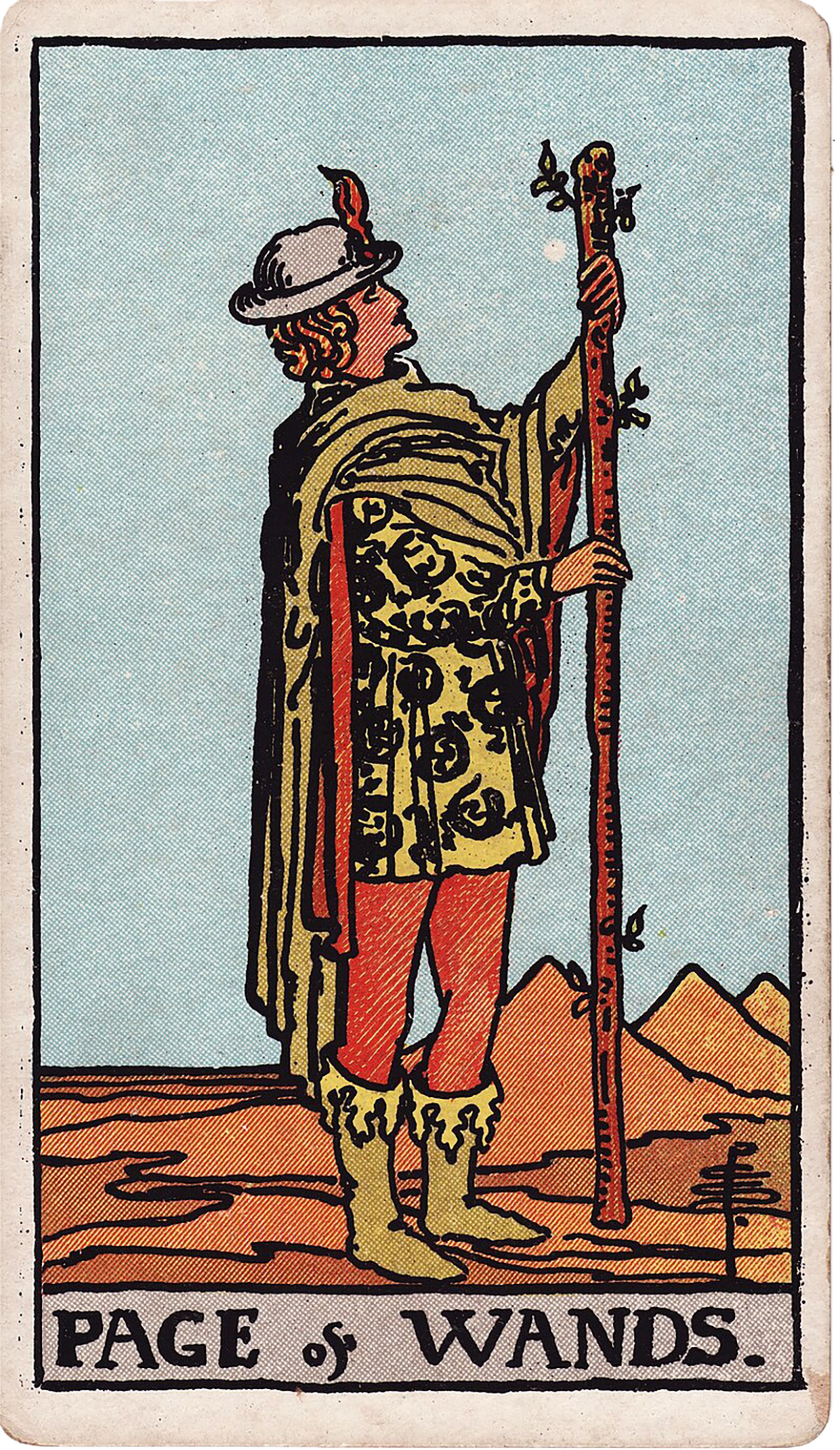 Page of Wands
Introduction — What this lesson covers
This single-card lesson explores the Page of Wands as shown in the supplied Tarot card images and uses those visuals as the primary evidence for interpretation. The Page of Wands is a court card in the suit of Wands, a fire suit associated with motivation, creativity, identity and the direction of energy. In the supplied upright description, Page of Wands highlights beginner energy in the realm of fire: curiosity, experimentation and a message or idea that invites exploration. In the supplied reversed description, the card draws attention to immaturity, inconsistency, or excitement without follow-through. Throughout this article we will: (1) read the imagery of the supplied cards using Rider-Waite-Smith symbolism; (2) translate that symbolism into concrete meanings for love, career, money, and creative projects; (3) show how to read upright and reversed forms; and (4) offer techniques, examples and practice exercises for learners. This is educational, not deterministic — use the card as a prompt and skill-builder rather than an absolute prediction.
How to approach a single-card reading
A single-card reading is an exercise in focused meaning-making. Because there are no contextual cards to soften, contradict, or specify, the single card must be read as both the core situation and the advice. Steps: (1) Center the question: make it specific (e.g., “What energy should I bring to this new job?” or “What is the next step for my relationship?”). (2) Observe the supplied Page of Wands image carefully: note posture, objects, landscape and clothing details. (3) Combine the observed visual symbols with the upright and reversed core statements supplied for this card. The supplied upright tells you to look for beginner energy, curiosity, practical response, and Wands skills. The supplied reversed asks you to notice where the process is stuck: immaturity, inconsistency, or a lesson not yet integrated. (4) Translate to context (love, career, money, creative work). (5) End with an action or practice rather than a judgment.
Key Rider-Waite-Smith symbolism in the supplied Page of Wands image
Anchor your reading in the picture. The Rider-Waite-Smith Page of Wands typically depicts a youthful figure standing in a desert plain, holding a single budding wand. When you look at the supplied card images, note these elements: - The young figure: suggests learning, initial enthusiasm, and a persona that is exploratory rather than authoritative. This is not the experienced leader of Wands (that would be the King); it is the starter. - The budding wand: a visible bud or leaves on the shaft show potential — something alive but not yet mature. That signals ideas, beginnings, and early-stage projects. - The desert landscape and distant mountains: the open, dry ground implies both freedom to travel and the need for resources; mountains far away suggest challenges exist but are not immediate. - Clothing and salamander motifs: salamanders are traditional fire symbols linked to transformation and resilience in the suit of Wands. On the supplied card the garments decorated with salamanders connect the Page to elemental fire energy — curiosity, restlessness, initiation. - Gaze and posture: the Page often looks at the wand with delighted curiosity or forward toward the horizon. That gaze indicates direction-setting and an interest in the unknown rather than focused completion. Read these visual cues alongside the supplied upright and reversed text to keep your interpretation grounded in what is shown.
Core upright meaning (practicalized)
Use the supplied upright text as the foundation: the Page of Wands highlights beginner energy in the realm of fire — curiosity, experimentation and a message or idea that invites exploration. Practically, this means: - You are in the early phase of an intention or concept. - The present task is to respond in a manner appropriate to starting: experiment, test, gather feedback, take low-stakes action. - The card suggests skills associated with Wands will help: motivation, creativity, initiative and identifying how you direct energy. When you read the supplied upright Page, ask: What small experiment could I run? What message do I need to share or receive? Where would a ‘try-and-learn’ approach be appropriate right now?
Core reversed meaning (practicalized)
The supplied reversed description directs attention to immaturity, inconsistency, excitement without follow-through, or fear of appearing inexperienced. For practical reading: - Look for patterns of scattered energy, starting projects but not finishing, or someone who talks big but acts little. - The reversal can indicate the lesson has been understood in theory but not practiced; it's an invitation to simplify and practice rather than to push harder. - It can also be an internal issue that others do not yet see: insecure feelings about starting or exposing vulnerability. When the Page of Wands appears reversed, ask: Where am I avoiding the basics? What small, repeatable practice would move this from idea to habit?
Page of Wands in Love and Relationships
Upright reading in love: Because the supplied upright emphasizes beginner energy and a message, in relationships the Page of Wands often signals a flirtation, a fresh spark, or an invitation to explore. If you are single, the card often points to an exciting new prospect or to a message that launches curiosity: a text that opens a conversation, a date that feels adventurous, or an interest in trying new social scenes. If you are partnered, the Page suggests bringing playful curiosity into the relationship — experiment with new activities, introduce small surprises, or start a new shared hobby. Visual cues from the supplied image reinforce this: the Page’s forward gaze and budding wand encourage the querent to look at what can be begun rather than what must be fixed. Reversed reading in love: The supplied reversed meaning warns of inconsistency or fear of looking inexperienced. In dating that can mean someone who moves fast but never commits, or you yourself might be excited about novelty but not ready for depth. In a relationship the reversed Page can point to immature communication styles (flirtation that avoids honesty), or avoidance of necessary routines that sustain intimacy. As practical advice: prioritize clarity — send the message you mean, and pick one small action to follow through on (e.g., schedule a date night and keep it).
Page of Wands in Career and Work
Upright career reading: The Page of Wands upright in the supplied card invites you to acknowledge early-stage ambition and to treat the current moment as experimentation. This might be a new job, a trial project, an internship, a proposal you are testing, or simply a sudden curiosity about a different field. The Page encourages low-cost tests: informational interviews, prototypes, pitch drafts, or a pilot project. The desert and mountains in the image suggest you have open terrain to explore but should be mindful of resources and eventual challenges. Reversed career reading: When reversed, the supplied meaning exposes inconsistency or immature ambition — someone who starts initiatives without planning or follow-through. In a work context that could be frequent job-hopping without skill development, half-finished projects, or overpromising on capabilities. It may also indicate internal doubts about competency. The practical move is to create a minimum viable routine: daily learning time, a checklist for completing small deliverables, or a mentorship conversation to convert enthusiasm into skill.
Page of Wands and Money/Finances
Upright money reading: The Page of Wands suggests small, nascent financial opportunities — a side hustle idea, a gig, a micro-investment, or a message about money (a job offer, small grant, or contract). The emphasis is on trying something in a low-risk way and treating finances like a learning laboratory. The budding wand image underscores that wealth-building here is at seed stage; it will need tending and iteration. Reversed money reading: The supplied reversed meaning warns of impulse spending on exciting but unplanned ventures, or of inconsistent income due to starting activities without sustainable structure. It can also indicate promising ideas that lack business basics. The recommended practice is budgeting for experiments: allocate a small, fixed amount for testing ideas, track outcomes, and avoid conflating enthusiasm with viability.
Page of Wands in Creative Projects
Upright creative reading: The Page of Wands is a quintessential creative spark card in its upright form. The supplied upright highlights curiosity and experimentation: the image of a budding wand is literal — a new creative concept ready to be explored. Use it as permission to sketch, draft, improvise and fail fast. The desert background supports open exploration without immediate deadlines. Reversed creative reading: When reversed, the supplied meaning of inconsistency and lack of follow-through becomes crucial: many idea-generating sessions without execution, or fear of showing early work. The card suggests reframing: rather than waiting for inspiration, set microsessions (15–30 minutes) to iterate, and accept imperfect outputs as steps. Practice turning one Page-idea into a tiny outcome you can evaluate.
Page of Wands as Advice and as Challenge
Advice (upright): Take a learner’s stance. Send the message, start the experiment, and accept that early results will be tentative. The supplied upright text emphasizes responding practically to the present stage and using Wands skills (initiative, creativity, identity). Use the Page’s posture and budding wand as an image to rehearse: hold your idea up, examine it, and then try one small action. Advice (reversed): Simplify and practice. The reversed Page asks you to spot where enthusiasm is outpacing habit. The practical instruction is to narrow the scope and set a repeatable routine — turn abstract knowledge into embodied skill. Challenge (upright): The challenge is not to overpromise; the Page’s initial energy needs boundaries so it doesn’t dissipate. Challenge (reversed): The challenge is inertia disguised as busyness or fear of starting because of vulnerability. The work is internal: accept beginner status and define the next smallest useful step.
Who might the Page of Wands represent in a spread
When the supplied Page of Wands appears as a person, read it as an archetype more than a literal age or gender label. The Page often represents someone young in spirit or experience: a newcomer to a field, an intern, a fresh recruit, a curious friend, or even an enthused junior colleague. Visually, the youth and lively costume on the supplied card signal enthusiasm and potential. Read the card as describing behavior: a person who brings messages, invites exploration, or shows inconsistency. If the card is reversed, it may represent someone who talks big but lacks follow-through, or who masks insecurity about being inexperienced.
Outcome and timing using the supplied Page of Wands
Single-card outcomes are directional rather than deterministic. Upright outcome: the supplied Page points to an ongoing developmental phase — you will likely be experimenting, learning and opening new possibilities. Expect incremental progress rather than immediate mastery. Reversed outcome: the supplied reversed meaning suggests the process will stall unless you change habits; the likely outcome is repeated starts without completion. Timing: court Pages are often associated with short-term cycles — weeks to months rather than years. Use the Page as an indicator that the important window is the near future and should be used for testing rather than launching a final product.
Common mistakes learners make with the Page of Wands
1) Treating it as a promise instead of a prompt: The Page is an invitation to experiment, not a guarantee of success. 2) Reading reversals as simply 'bad': The supplied reversed text is diagnostic — it shows where the process is stuck — not a moral condemnation. 3) Ignoring imagery: Relying only on keywords and ignoring the budding wand, desert or salamander motifs loses nuance. 4) Over-personalizing the card: The Page is archetypal; avoid assuming a specific age or gender unless the client or querent’s life clearly supports that reading. 5) Failing to give practical next steps: The Page asks for action appropriate to a beginning stage; without it the reading is theoretical. 6) Forcing scope: Because the Page is about beginnings, avoid interpreting it as the endpoint or final outcome.
Practical reading method and two mini-spreads
Method for a single-card Page reading: 1) Ask one clear question. 2) Spend 60–90 seconds silently observing the supplied Page of Wands image; name three concrete things you see. 3) State whether the card landed upright or reversed and read the corresponding supplied core text out loud. 4) Translate the core text into one specific action (e.g., send that email, write one page, test one marketing idea). 5) Close with a timebound experiment: commit to one outcome in the next seven to fourteen days and set a measure (did I send the message? did I publish a draft? did I run one pitch?). Two mini-spreads using only the supplied Page: A) Three-step experiment spread: Position 1 — where curiosity is now (draw the Page upright/reversed and describe which part of the image maps to current reality); Position 2 — the simplest next action (what one small act does the Page suggest?); Position 3 — how to measure progress (what will indicate you learned something?). B) Relationship starter spread: Position 1 — What new energy is available? (Page imagery shows a budding start). Position 2 — What to communicate? (use the Page’s forward gaze as a metaphor for a message). Position 3 — What to avoid? (if reversed, name the consistency traps). After either mini-spread, return to the supplied imagery and ask: which detail in the card confirms this action?
Case examples (brief)
Example 1 — Love, upright: Querent single, asks if they should message someone they met. The supplied Page of Wands upright shows a budding wand and forward gaze — advice: send a curious, low-pressure message that suggests an activity (a short invite), treat the exchange as a test rather than a commitment. Example 2 — Career, reversed: Querent says they keep leaving jobs. The supplied Page reversed points to inconsistency — advice: identify the pattern, create a 90-day skill development plan and commit to a measurable competency before moving on. Example 3 — Creative project, upright: Querent has many ideas and asks where to start. Supplied Page upright suggests picking one idea, making one sketch or outline, and testing it publicly in a tiny way to gather real feedback.
Practice exercises for learners
1) Visual journaling: Spend five minutes describing the supplied Page of Wands image in sensory detail. Then write two possible interpretations for a love question and two for a career question, grounding each interpretation in one visual element. 2) Micro-experiment log: After a Page reading, pick one micro-action (15–30 minutes). Log what you did and one tangible metric. Repeat for seven days to train follow-through. 3) Reverse exploration: When Page appears reversed to you in practice readings, write a one-paragraph dialogue between your enthusiastic beginner self and your cautious self. Note what the cautious self needs to see to allow experimentation.
Putting it all together — interpretation logic
When the supplied Page of Wands appears, always loop between three steps: image → supplied core text (upright or reversed) → specific action. The image anchors, the supplied text frames the pattern, and the action converts meaning into practice. For example: you notice a budding wand (image), remember the upright line about beginner energy and a message that invites exploration (supplied text), and then choose to send a short message or create a one-page test (action). If reversed, the same loop helps you identify the exact point of blockage (e.g., fear of appearing inexperienced) and choose a micro-practice to change it. This logic creates readings that are concrete, teachable and repeatable.
Closing notes and ethical reminders
Use the supplied Page of Wands as a mirror and a prompt rather than a verdict. The single-card context gives a concentrated lesson: act like an experimenter or notice where practice is lacking. Encourage querents to keep records and to test the card’s advice in short cycles. Avoid making absolute promises about outcomes and always balance encouragement with practical next steps. The supplied imagery and the Rider-Waite-Smith symbolism together give a vivid, repeatable set of cues that learners can use to build confidence with court-card readings.
Practice questions
• When I look at the supplied Page of Wands image, which single visual detail speaks most strongly to my situation and why?
• If the Page of Wands is urging an experiment, what is the one smallest test I can run in the next week?
• Where in my life do I behave like the Page reversed — excited to start but not to practice — and what habit could I introduce to change that?
• How does the desert and distant mountains in the supplied image influence my assessment of resources and challenges for this situation?
• What message do I need to send or receive right now that would move this Page-energy into a concrete next step?
• Who in my network embodies healthy Page energy (curious and consistent), and what can I learn from their approach?
Comments
Sign in to comment.
Continue learning
Interpreting the Dance of Justice and The Devil: Balancing Morality and Temptation in Tarot Readings
The combination of Justice and The Devil in tarot presents a profound exploration of morality, temptation, and personal accountability. This article unpacks how these cards influen...
Understanding The World Card in Personal Completion and New Cycles
The World card in tarot signifies completion, integration of lessons learned, and the threshold of new cycles. This article explores its nuanced meanings in upright and reversed po...
Mastering Tarot Timing Techniques for Accurate Readings
Timing in tarot readings can transform vague predictions into clear guidance about when events might unfold. This article explores practical timing techniques for beginners and adv...
Unlocking the Power Balance of The Emperor The Hierophant and Justice in Tarot Combinations
This article offers a deep exploration of the combined meanings of The Emperor, The Hierophant, and Justice cards within tarot spreads, focusing on how their energies interact to p...
Unlocking Leadership Qualities Through the Knight Queen and King of Wands
The Knight, Queen, and King of Wands embody evolving leadership qualities within the family suit of Wands. This article unpacks their traditional symbolism and the lessons each cou...
Mastering the Art of Combining The Magician The Empress and Ace of Pentacles for Manifestation and Abundance
This article offers a comprehensive exploration of how to skillfully combine The Magician, The Empress, and Ace of Pentacles tarot cards to enhance manifestation and attract abunda...
Mastering Intuitive Tarot Reading with The High Priestess The Hermit and The Moon for Deeper Insights
This article guides Tarot readers through mastering intuitive reading skills using three powerful cards: The High Priestess, The Hermit, and The Moon. It covers both beginner and a...
Unlocking Leadership and Responsibility Lessons Through the Court Cards of Swords
This article delves into the Court Cards of Swords—the Page, Knight, Queen, and King—to uncover the nuanced lessons they provide about leadership and responsibility. Rooted in the...
Exploring the Symbolic Language and Elemental Correspondences of the Court Cards of Cups for Emotional and Intuitive Insight
This in-depth article examines the Court Cards of Cups within the Rider-Waite-Smith tradition and the VoxFati Tarot Library context. It explores their rich symbolism and elemental...
Interpreting the Page of Swords for Career Love and Personal Growth
This article teaches how to read the supplied Page of Swords single-card draw across multiple life contexts. Using the card's Rider-Waite-Smith imagery and the provided upright and...