
Reading the Four of Pentacles for Money Home and Emotional Boundaries
This article teaches how to read the 4 of Pentacles as a single-card lesson across contexts — money, home, career, love, advice, challenge, person, outcome and spiritual reflection. Using the supplied 4 of Pentacles image and its upright and reversed texts, the piece ties Rider-Waite-Smith symbolism to practical questions, step-by-step single-card methods, example readings, common mistakes and exercises for learners.
Cards explored in this article
 4 of Pentacles
Introduction: Why single-card focus matters
A single-card lesson asks you to make one card do a lot of work. The supplied 4 of Pentacles card is rich: its imagery and the supplied upright and reversed texts point to a tension between protecting resources and becoming rigidly controlled by that need. Working with one card sharpens your ability to notice nuance, anchor readings in imagery and translate symbolic detail into grounded, practical advice. This article treats the 4 of Pentacles as the only specific tarot image available and repeatedly ties interpretations to the exact figure and symbols seen on that card. Read this as a learning tool, not a guaranteed prediction.
Look first at the supplied texts for the 4 of Pentacles
Begin by reading the supplied definitions for the 4 of Pentacles and letting them set the interpretive frame. Upright, the supplied text reads: "Upright, 4 of Pentacles highlights protecting resources and creating stability, while questioning when security turns into rigid control. The card is practical: it asks for a response that fits the present stage rather than an abstract ideal. Consider where this pattern is already visible and what action would strengthen its constructive side. In many spreads, the upright card shows that the situation can be handled through the skills associated with Pentacles: work, money, health, routine, resources, craft, the body and long-term material stability. It can still contain effort or discomfort, but it usually makes the core task easier to name. Use the surrounding cards to see whether this energy is beginning, developing, reaching pressure, or moving toward resolution." Reversed, the supplied text reads: "Reversed, 4 of Pentacles draws attention toward hoarding, fear of loss, possessiveness, financial rigidity or beginning to loosen control and allow resources to circulate. The reversal may show too much of the card's usual energy, too little of it, or a situation where the lesson is understood intellectually but not yet lived consistently. It can also indicate that the issue is occurring internally and is not obvious to other people. Rather than treating the reversed card as the opposite of the upright meaning, examine where the process has become stuck. Ask what needs to be simplified, acknowledged, practiced, released, or communicated before the healthier expression of Pentacles can return." Keep these as your anchor while you work through contexts and techniques below.
Read the image first: Rider-Waite-Smith symbolism on the supplied 4 of Pentacles
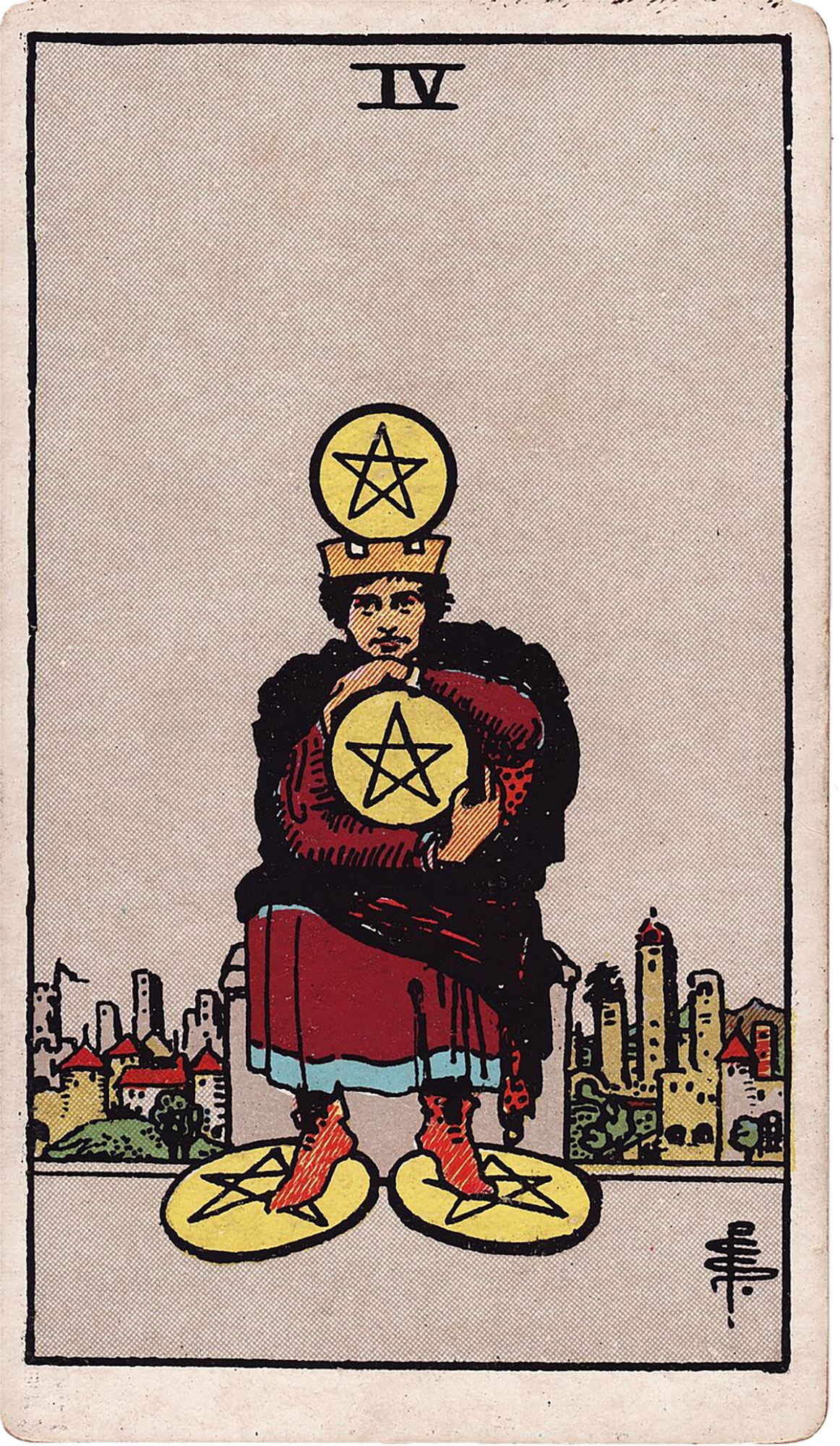
When you look at the supplied 4 of Pentacles image, take a slow visual inventory. The traditional Rider-Waite-Smith elements visible on this card include: a seated man holding tightly to a pentacle against his chest, another pentacle beneath his feet, a third tucked under one foot and a fourth set on his head like a crown. He sits in front of a city or stronghold. Note the posture: closed, protective, tense. His cloak and position imply insulation and privacy. The pentacles' placement—on head (thoughts/values), chest (heart/holding), and feet (foundation/territory)—gives a map of where holding patterns appear. The castle behind him suggests material security or status that can be defended. In short, the image visually describes an economy of holding: what is kept in place, what is pressed down, and what is crowned by possession. Anchoring readings to these visual cues helps you avoid abstract generalities and keeps the interpretation grounded in the card you actually have in front of you.
How to decide upright or reversed in single-card practice
If you are doing a single-card draw, determine orientation at the moment you look. The supplied text already frames upright and reversed as different shades of the same process rather than opposites. Treat orientation as a clue about whether protective energy is functioning (upright) or stuck/over-accumulated/starting to release (reversed). Always verbalize orientation aloud before you interpret: "4 of Pentacles upright: holding to stabilize" or "4 of Pentacles reversed: hoarding, or loosened grip." Doing so trains your mind to use the supplied definitions as immediate reference points.
Money and material resources
Upright reading: When the supplied 4 of Pentacles appears upright for a money question, it usually signals conservative fiscal behavior and a focus on building or protecting a material base. The card's visual—pentacles at head, chest and feet—shows a person who thinks about money (head), ties money to security and identity (chest), and uses money for foundation (feet). Apply the upright text: protection and creating stability are the first, neutral readings. Ask: Are you making prudent reserves? Is your energy currently best used for consolidation rather than expansion? The practical action is to inventory resources, build a realistic buffer, and avoid risky moves until you have the security you need. The upright can also warn: watch for rigidity. The man on the card is not relaxed in his grip; too much holding can prevent investment, generosity or necessary spending on growth. Reversed reading: The supplied reversed text points to hoarding, fear of loss, possessiveness or the start of loosening control. For money questions, reversed 4 of Pentacles may show a pattern of clinging so tight that chances are missed—refusing reasonable investments, delaying necessary purchases or keeping money in unproductive ways out of fear. Alternatively, reversed may indicate the beginning of release: you’re finally allowing funds to circulate after an extended hold. Ask: Does fear of scarcity shape your choices? Would a gradual redistribution (emergency fund + controlled investment) serve you better than total withholding? Recommended technique: use small, safe experiments with spending or giving to test whether you can tolerate more resource flow.
Home, property and living situation
Upright reading: The supplied imagery and text map well to questions about home. Upright, the card can indicate a stable living situation, ownership, or taking practical steps to secure shelter: paying down mortgage, organizing possessions, creating household budgets. The castle behind the sitter visually supports ideas of property and status. But the posture warns: is the home a fortress of control? The card can signal clinging to a place for identity or status rather than comfort. Ask: Is the living space serving your needs or preserving an image? Reversed reading: Reversed, the 4 of Pentacles can show fear of losing a home leading to excessive control—over roommates, finances, or household decisions—or, alternatively, the start of letting go: decluttering, moving, or sharing space more freely. The reversed card might indicate that the issue is mostly internal: anxiety about losing shelter that isn’t visible to others. Practical approach: make a clear household plan (budget, list of essentials), and test whether loosening a control (sharing storage, reassigning space) reduces stress without threatening security.
Love and emotional boundaries
Upright reading: Mentally place the supplied 4 of Pentacles image over matters of the heart. The pentacle held at the chest is a vivid visual cue: this is about what you protect emotionally. Upright, the card often describes a person keeping their heart guarded—creating firm boundaries to protect themselves from past wounds or to keep a sense of independence. That guardedness can be healthy when it means stable, clear boundaries; it becomes problematic when it is possessiveness or fear-based control. In relationships, ask whether protection is a temporary stage or a habit that shuts down vulnerability. Reversed reading: Reversed, you may see possessiveness or the opposite—emotional detachment as a defense. The reversal may show hoarding affection or withholding intimacy; alternately, it can show the beginnings of vulnerability as someone relaxes their hold and allows feelings to circulate. When the reversed 4 of Pentacles appears, ask: What must be shared to build trust? Which small acts of vulnerability would test the safety of the relationship without risking your core stability?
Career and professional life
Upright reading: In career questions, upright 4 of Pentacles signals cautious resource management: saving salary increases, defending a position, or building stable professional routines. The castle behind the sitter may indicate a secure position or a company with rigid structures. The practical prompt is to consolidate skills, build reliable income streams and avoid impulsive career switches until your foundation is stronger. Reversed reading: Reversed warns that excessive conservatism may keep you stuck: refusing necessary risk, hoarding information, or protecting a title at the cost of growth. It can also show the start of a change—sharing responsibilities, delegating, or investing in new skills. Recommended action: create a controlled risk plan (small training expense, mentorship time, a low-stakes project) that allows growth without destabilizing your financial base.
Advice and action steps
When the supplied 4 of Pentacles appears as advice, translate its energy into practical tasks. Upright advice: inventory and stabilize. Make a list of tangible steps: emergency fund target, fixed-cost reduction, schedule for health routines, or clear household rules. Use the card’s crown pentacle (head) as a cue to clarify values—what are you protecting and why? Reversed advice: examine fear. Are you hoarding in response to scarcity stories? The supplied reversed text suggests asking what needs to be simplified, acknowledged, practiced, released, or communicated. Turn that into action: a donation to test generosity, a conversation about boundaries, a small planned expense to reintroduce resource circulation. In both orientations, favor measurable small actions over philosophical resolutions.
The 4 of Pentacles as a person or persona
If the supplied card represents a person, read the image directly. This is someone pragmatic, conservative, and deeply concerned with security. They may present as reliable and steady but also as controlling or fearful around loss. The pentacle-on-head detail suggests someone whose thoughts are filtered through values about ownership; the one at their chest implies they take possessions personally. Remember the supplied reversed text: if reversed, the person may appear oddly detached, stingy, defensive, or in the process of loosening up. Avoid moral judgment; instead, locate the need behind the behavior—often fear of instability or prior hurt.
Outcome readings and time nuance
Single-card outcome readings with the supplied 4 of Pentacles require attention to whether stability is the desired outcome or stagnation. Upright can indicate a steady, durable resolution: security achieved through careful planning. But outcomes are rarely wholly positive—this card's crown suggests a cost. Ask: Will this outcome preserve freedom and flexibility in the long run? Reversed outcomes show movement: either the unhealthy habit loosens (good) or hoarding intensifies into self-sabotage (bad). Use precise follow-up questions: "What will I be able to do after stabilizing?" or "What will I lose if I continue to tightly control the situation?"
Spiritual reflection and the earth element
The 4 of Pentacles is a Pentacles card—earth element territory. Spiritually, the card invites reflection on attachment and stewardship. The supplied image maps where attachment sits in your life: head, chest, feet. Upright it asks you to practice stewardship: be reliable, honor material responsibilities, and cultivate embodied security. Reversed it asks you to examine clinging—what inner scarcity story drives your actions? Exercises: body-centered awareness (notice where you hold tension in belly and chest like the figure), journaling about the beliefs you hold about safety, and ritualized giving to test the flow of resources. The spiritual reading reframes money and possessions as mirrors of inner states rather than final ends.
Practical single-card reading method using the supplied 4 of Pentacles
Step 1: Set intention. Name the context aloud: "Money","Home","Relationship","Career","Advice" etc. Step 2: Shuffle and draw. Note orientation and place the card before you. Step 3: Describe the image out loud, pointing to the pentacles at the head, chest, feet and the castle behind him. Anchor your words in what you actually see on the supplied 4 of Pentacles image. Step 4: Read the supplied upright or reversed text as your primary lens. Step 5: Ask context-specific probing questions (examples below). Step 6: Decide on one measurable next step. If you need nuance, draw one or two clarifier cards, or use a three-step clarifier process with questions: "What is the fear here?" "What is the benefit of holding?" "What is the next small step?" (If you draw clarifiers, treat them as additional data, but anchor your interpretation in the original 4 of Pentacles imagery.) Suggested probing questions tied to the supplied card: "What am I protecting and why?" "Where am I too rigid, and what cost is that rigidity producing?" "What practical buffer would allow me to release control safely?"
Example readings that model approach
Example 1 — Money, upright: A client draws the supplied 4 of Pentacles upright for a question about whether to invest in a small business. Follow the method: note orientation and image. Interpretation: The card signals a need to consolidate first. Action: build a six-month emergency fund and create a small pilot budget before committing capital. Example 2 — Home, reversed: The client asks about moving. The 4 of Pentacles reversed appears. Interpretation: There is internal fear about losing home; perhaps possessions are being hoarded. Action: conduct a decluttering/donations experiment and set a moving checklist to see if letting go reduces anxiety. Example 3 — Relationship, upright: The card appears upright for a question about intimacy. The image suggests guardedness. Interpretation: Boundaries may be serving as safety. Action: practice one small vulnerability (share one worry) and track the partner's response. In each example, anchor every interpretive claim to the visual cues on the supplied card and reference the supplied upright/reversed text as the guiding frame.
Common mistakes and how to avoid them
Mistake 1: Reading the 4 of Pentacles only as "greedy/stingy." Avoid moralizing. The card often represents protection, not malice. Mistake 2: Treating reversed as simply the opposite. The supplied reversed text specifically warns against that approach. Instead, look for where the process is stuck, overdone, or beginning to shift. Mistake 3: Ignoring visual detail. The pentacle positions are meaningful—use them. Mistake 4: Overlooking context labels. A "money" 4 of Pentacles and a "relationship" 4 of Pentacles point to different territories of holding. Mistake 5: Offering only abstract advice. Translate images and supplied text into measurable steps (list, budget, conversation, declutter schedule).
Practice exercises for learners
Exercise 1: Do ten single-card 4 of Pentacles draws (or simulate orientation mentally if you don’t own many decks). For each draw, attach one context (money/home/relationship/career/advice), describe the image, quote the applicable supplied text in one sentence, and write one concrete next step. Exercise 2: Somatic mapping—sit quietly, look at the supplied image, and notice where you feel tension in your own body. Journal the associations: chest tension = guarded heart; tight ankles/feet = clinging to territory. Exercise 3: The "experiment of giving"—if you read the card as hoarding, plan a small, controlled act of resource circulation (donate 5% of an envelope of cash, share a household item, offer time) and record the emotional effects over two weeks. These exercises train you to connect image, text and practical action.
Closing notes and ethical considerations
The supplied 4 of Pentacles is a powerful teaching card because it sits at the intersection of protection and paralysis. As a reader, maintain ethical clarity: don’t push large financial or life changes on querents; instead, translate symbolism into incremental, testable steps. Use the supplied upright and reversed texts as your interpretive anchor and always tether readings to the card’s visible detail—the pentacle placements and the fortress behind the sitter. Single-card lessons sharpen your ability to read nuance and offer usable guidance. Keep practice regular, reflect on outcomes, and let the card teach you where stability serves and where release becomes necessary.
Practice questions
• What am I currently protecting and how does that protection serve me?
• Where do I feel most tense in my body when I look at the supplied 4 of Pentacles image?
• When have I confused stability with control, and what would a small test of letting go look like?
• If the pentacle at the head, chest and feet were labeled 1–3, which one is most activated in my life now?
• What measurable small step could shift a pattern of hoarding into healthy circulation?
Comments
Sign in to comment.
Continue learning
Interpreting the Dance of Justice and The Devil: Balancing Morality and Temptation in Tarot Readings
The combination of Justice and The Devil in tarot presents a profound exploration of morality, temptation, and personal accountability. This article unpacks how these cards influen...
Understanding The World Card in Personal Completion and New Cycles
The World card in tarot signifies completion, integration of lessons learned, and the threshold of new cycles. This article explores its nuanced meanings in upright and reversed po...
Mastering Tarot Timing Techniques for Accurate Readings
Timing in tarot readings can transform vague predictions into clear guidance about when events might unfold. This article explores practical timing techniques for beginners and adv...
Unlocking the Power Balance of The Emperor The Hierophant and Justice in Tarot Combinations
This article offers a deep exploration of the combined meanings of The Emperor, The Hierophant, and Justice cards within tarot spreads, focusing on how their energies interact to p...
Unlocking Leadership Qualities Through the Knight Queen and King of Wands
The Knight, Queen, and King of Wands embody evolving leadership qualities within the family suit of Wands. This article unpacks their traditional symbolism and the lessons each cou...
Mastering the Art of Combining The Magician The Empress and Ace of Pentacles for Manifestation and Abundance
This article offers a comprehensive exploration of how to skillfully combine The Magician, The Empress, and Ace of Pentacles tarot cards to enhance manifestation and attract abunda...
Mastering Intuitive Tarot Reading with The High Priestess The Hermit and The Moon for Deeper Insights
This article guides Tarot readers through mastering intuitive reading skills using three powerful cards: The High Priestess, The Hermit, and The Moon. It covers both beginner and a...
Unlocking Leadership and Responsibility Lessons Through the Court Cards of Swords
This article delves into the Court Cards of Swords—the Page, Knight, Queen, and King—to uncover the nuanced lessons they provide about leadership and responsibility. Rooted in the...
Exploring the Symbolic Language and Elemental Correspondences of the Court Cards of Cups for Emotional and Intuitive Insight
This in-depth article examines the Court Cards of Cups within the Rider-Waite-Smith tradition and the VoxFati Tarot Library context. It explores their rich symbolism and elemental...
Interpreting the Page of Swords for Career Love and Personal Growth
This article teaches how to read the supplied Page of Swords single-card draw across multiple life contexts. Using the card's Rider-Waite-Smith imagery and the provided upright and...