
Seven of Wands for Standing Your Ground in Love Work and Inner Confidence
This single-card lesson focuses on the 7 of Wands as shown in the supplied card images. Upright, the 7 of Wands highlights defending hard-won ground, applying Wands skills (motivation, initiative, identity) and making practical choices about what to protect. Reversed, the card points to defensiveness, exhaustion, boundary issues, or a lesson understood intellectually but not embodied. Using the Rider–Waite–Smith imagery on the supplied 7 of Wands, this article teaches how to read the card in love, career, money, advice, challenge, person, outcome, and spiritual reflection contexts. You will find technique, interpretation logic, common mistakes, practical reading methods, sample mini-readings, and exercises to build competence and confidence with this card.
Cards explored in this article
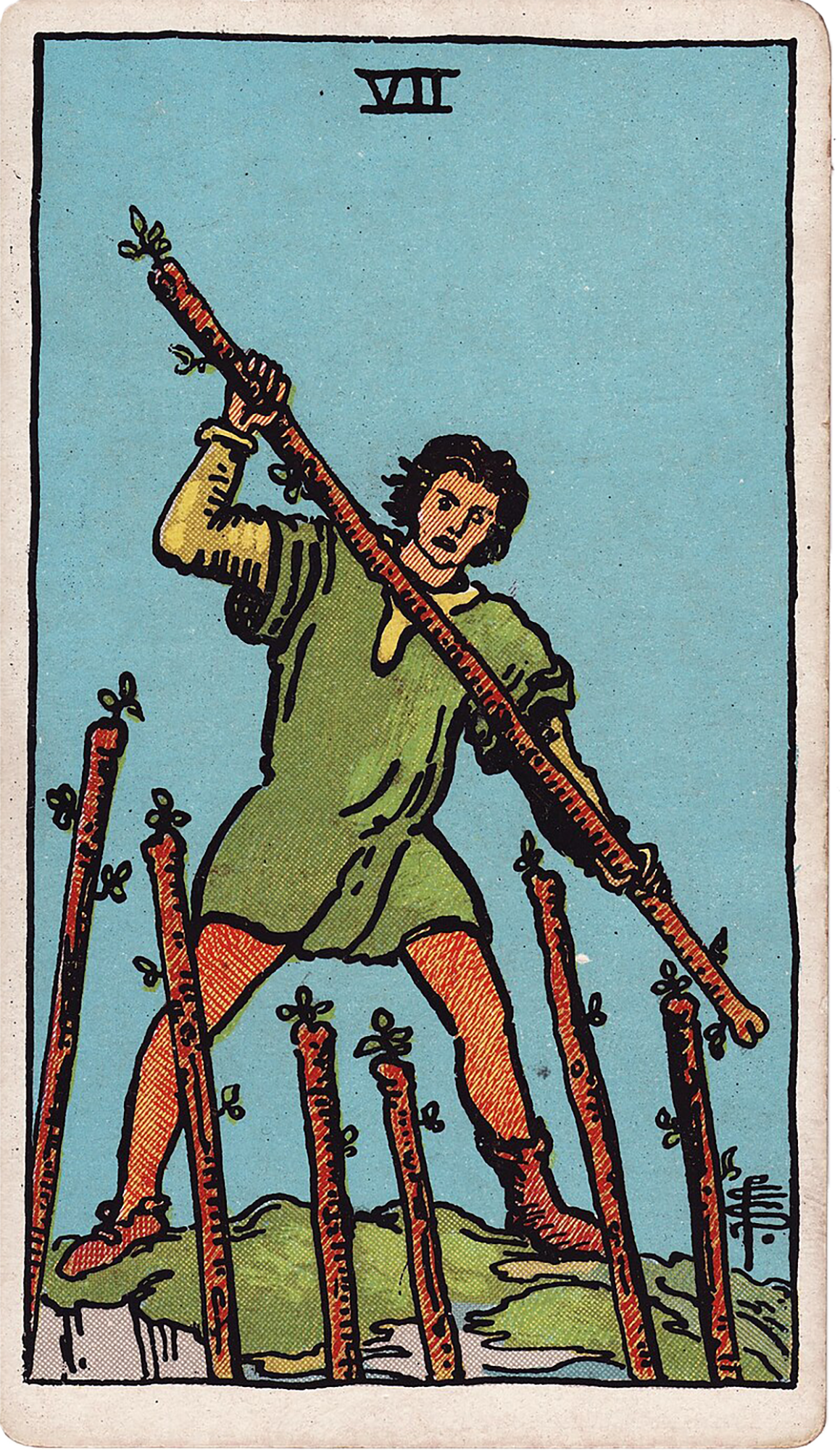 7 of Wands
Introduction to this Single-Card Lesson
This lesson examines the supplied 7 of Wands image as the only card in a spread and as the focal point when interpreting a situation. Single-card readings are compact teaching tools: they force you to focus on essentials, the card's visual language, and how that energy shows up in a querent's life. The 7 of Wands in the supplied images is an excellent case study because the Rider–Waite–Smith symbolism is direct and dynamic: a lone figure standing on higher ground and fending off six wands aimed up at him. We'll use that picture and the provided upright and reversed texts to connect image, meaning, and practical advice across multiple contexts.
Card Overview: Upright and Reversed Meanings
Use the supplied descriptions as your baseline. Upright, the 7 of Wands highlights holding ground when values or hard-won progress are challenged; confidence is strengthened by knowing what is worth defending. It asks for a response that fits the present stage rather than an abstract ideal and suggests the situation can be handled through Wands skills: motivation, creativity, ambition, initiative, identity, and the direction of energy. Reversed, the 7 of Wands draws attention toward defensiveness, exhaustion, poor boundaries, or fighting every challenge instead of choosing battles wisely. The reversal may indicate too much of the card's usual energy, too little of it, or an internal struggle that hasn't become visible externally. Rather than treating reversed as simply 'bad,' investigate where the process is stuck and what needs simplification, acknowledgment, practice, release, or communication before the healthier Wands expression returns.
Rider–Waite–Smith Symbolism Anchored to the Supplied Cards
When you study the supplied 7 of Wands image, several symbolic elements anchor the card's meaning: - The raised position: The lone figure stands on a slope or ridge, literally holding higher ground. This height symbolizes advantage, perspective, and the justification to defend what has been earned. In readings, ask what position the querent already holds that merits defense. - The figure's posture and grip: He leans forward, gripping the wand with both hands. That stance communicates active engagement, exertion, and personal responsibility rather than passive victimhood or aggression for its own sake. - The incoming wands: Multiple staves rising from below suggest external opposition, competing demands, or challenges arriving simultaneously. They are not shown as people—this makes the conflict feel like forces or pressures that must be managed rather than a single antagonist. - The landscape and sky: The sky is often plain or slightly clear in Rider–Waite depictions. That absence of storm can indicate that the fight is not about weathering catastrophe but about exerting will within the ordinary pressures of life. - Clothing and gender-neutral body language: The figure's clothes and bare legs show action-readiness. The focus is on capacity and will rather than on social role, giving the card a universal message about personal agency. Use these visual cues from the supplied 7 of Wands to connect concrete details to abstract advice. Learners should practice naming each visible symbol and then articulating a short meaning for readings: 'higher ground = earned advantage; incoming wands = pressure; forward stance = active defense/initiative.'
How Interpretation Changes by Context: Love
Upright in love: When the supplied 7 of Wands appears upright for a love question, the immediate image—someone holding ground on a ridge—points to defending a relationship boundary, protecting a shared value, or standing up for your needs after progress has been made. This could be a partner who is asserting a newly stated boundary, a person defending a relationship against critics, or one partner taking initiative to protect the trust they have built. Ask whether the querent is choosing to accept discomfort to keep what matters; the card favors practical responses over grand romantic ideals. Reversed in love: The supplied 7 of Wands reversed warns about unnecessary defensiveness, exhausting conflict, or failure to conserve energy in relationship disputes. The reversal may show a partner who reacts to every slight, or someone who claims to 'stand their ground' but actually resists intimacy. The image of the lone defender now points inward—ask whether the fight is internal (fear of vulnerability) rather than external. The reading should explore simplifying communication, setting better boundaries, or stepping back to select which issues deserve attention.
How Interpretation Changes by Context: Career and Work
Upright in career: The figure on higher ground is a potent workplace symbol: you may be defending a job position, protecting hard-won recognition, or asserting a new role. The supplied 7 of Wands suggests mobilizing initiative, asserting expertise, and applying ambition constructively. The challenges may be multiple—competing projects, colleagues, or external pressures—but the card emphasizes that you have enough of an advantage to hold the line. Practical questions include: what evidence supports your position? Which skills are you already using to keep this ground? Reversed in career: The reversal points to burnout, reactive behavior, or fighting every small threat. On the supplied card, the defender's stance becomes strained; in a work reading this suggests poor boundary management, taking on too many tasks, or a drain from constant conflict. It can also signal that the real issue is internal—imposter feelings or self-doubt—so interventions include delegation, prioritizing, learning to say no, and simplifying objectives.
How Interpretation Changes by Context: Money and Resources
Upright in money readings: Financially, the supplied 7 of Wands upright asks you to defend savings, investments, or a budget choice that you've made. The image of holding higher ground translates to preserving gains or continuing a disciplined plan even when outside pressures tempt spending or risky moves. This card favors practical, steady defense over speculative expansion. Reversed in money readings: The reversal can indicate financial exhaustion, overprotectiveness (hoarding), or reactive financial moves prompted by anxiety. It can also show that the person fights every perceived threat to money rather than distinguishing urgent risks from noise. Encourage simplification of financial systems, setting clearer priority categories (needs, wants, emergency), and stopping repetitive defensive behaviors that cost time or opportunity.
How Interpretation Changes by Context: Advice and Action
Upright as advice: The supplied 7 of Wands upright advises taking a practical stand where it matters and using active initiative. Translate the visual cues into action phrases: 'Hold what is essential,' 'defend your boundaries,' 'use energy where it yields protection.' The card asks you to name the specific 'ground' you are on and to act rather than rhetorically defend values. Reversed as advice: When reversed, the supplied card advises reassessment. Ask which battles are worth the emotional cost. Practice choosing fewer fights and conserving strength. The card may also advise practicing boundary-setting skills or expressing a problem to others to reduce internal rumination.
How Interpretation Changes by Context: Challenge or Obstacle
Upright as a challenge: The supplied 7 of Wands upright can be the situation itself: you are under pressure and must hold your position. The image focuses you on pragmatic defense. Identify the pressures (the incoming wands), inventory your strengths, and pick a manageable tactic. Reversed as a challenge: The reversal often signifies an internal snag—exhaustion, defensiveness, or boundary collapse—that needs repair before progress can resume. The supplied image suggests the defender is losing efficient form; the challenge is to simplify or to seek support, not to escalate confrontation.
How Interpretation Changes by Context: Person or Energy
Upright as person/energy: Read the supplied 7 of Wands upright as someone who is assertive, energetic, and protective of what they have earned. They are willing to stand alone, take initiative, and accept strain for meaningful goals. This energy can be positive (courageous defender) or strenuous (tireless advocate). Reversed as person/energy: The reversed 7 of Wands may describe someone defensive, touchy, or perpetually exhausted by perceived threats. It can also be someone who looks assertive but is actually inconsistent—capable in rhetoric but not in steady action. In readings, explore whether the querent or another person matches the imagery on the supplied card.
How Interpretation Changes by Context: Outcome and Resolution
Upright as outcome: If the supplied 7 of Wands appears upright as an outcome, expect a situation where the querent successfully holds important ground. There may be effort, but the result is framed as justified defense: the person keeps what matters by using Wands skills—initiative, identity, and focused energy. Reversed as outcome: As an outcome, reversal warns that continued fighting without selectivity leads to burnout or destabilization. The supplied image then becomes a cautionary tale: victory may be hollow if it costs well-being. Outcomes require asking whether maintaining the ground is truly valuable, and whether changes to strategy are necessary.
How Interpretation Changes by Context: Spiritual Reflection
Upright spiritually: The supplied 7 of Wands upright invites reflection on inner integrity and the courage to live a chosen path. The figure on higher ground suggests moral or spiritual convictions that must be protected from distraction or dilution. The card asks: what practices or commitments are you defending, and are they aligned with your deeper purpose? Reversed spiritually: Reversed, the supplied card asks you to notice defensive reactions that block spiritual growth: pride, fear of change, or clinging to identity constructs. The shadow here is defensive rigidity rather than flexible, grounded faith or practice. The spiritual task may be to release what you are over-protecting so that truer values can emerge.
Interpretation Logic: Reading the Supplied 7 of Wands Step by Step
A disciplined approach will keep interpretation grounded and teachable. Use this stepwise method when the 7 of Wands is the only card: 1) Observe the image carefully: On the supplied 7 of Wands, list what you see—the slope, the defender, the incoming wands, posture, clothing, sky. Don't skip this. 2) Recall the supplied upright/reversed key phrases: Upright = holding ground, practical response, Wands skills; Reversed = defensiveness, exhaustion, stuck process. 3) Ask the context question: Love? Career? Money? Advice? Person? Outcome? Spiritual reflection? This frames which element of the image maps to the querent's life. 4) Translate visual details to specific situation elements: Higher ground = advantage or value; incoming wands = external pressures; forward grip = necessary work/initiative. 5) Formulate concrete advice using present-tense action statements: 'Name what you will defend,' 'Say no to tasks that dilute your effort,' 'Practice a clear boundary conversation.' 6) Test with follow-up questions: Who benefits if I hold this ground? What exactly is at risk? Is this fight serving my long-term aims? 7) If reversed, add a 'stickiness' check: Where is the pattern repeating? What needs simplifying, acknowledged, or released? This logic trains students to move from image to meaning to actionable guidance without inventing details not present in the card or context.
Practical Reading Method and Sample Mini-Readings
Method for a one-card session using the supplied 7 of Wands: - Step A: Clarify the question. Encourage a specific, time-limited query: 'What should I focus on this month regarding my promotion?' instead of 'What does my career look like?' - Step B: Look at the supplied card for one minute, naming visible elements aloud. - Step C: State whether the card is upright or reversed and read the corresponding supplied lines silently. - Step D: Map the imagery to the context and propose 2–3 concrete next steps. - Step E: Offer a short validation statement about what strengths are present and one limitation to watch. Three brief examples anchored to the supplied card: Example 1 — Love, upright: Querent asks about defending a relationship boundary after a disagreement. Observation: figure on higher ground facing many wands. Interpretation: You have already gained trust; now you must assert the boundary coherently and calmly. Advice: Say the boundary once, state why it matters, and let the partner respond. Avoid repeating defenses; pick the essential point. Example 2 — Career, reversed: Querent asks about handling a hostile team. Observation: same image but reversed meaning suggests exhaustion. Interpretation: You are fighting constant minor slights and spreading yourself thin. Advice: Prioritize one deliverable, document accomplishments, and use delegation. Consider whether the environment asks for constant defense rather than fair assessment. Example 3 — Money, upright: Querent asks about resisting impulsive spending. Observation: higher ground = established savings; incoming wands = temptations. Interpretation: Keep the plan; small discomfort is temporary and worth long-term stability. Advice: Automate savings, reduce exposure to triggers, and name the single goal you defend.
Common Mistakes and How to Avoid Them
Learners make predictable errors with the 7 of Wands. Here are the most common and how to correct them: - Mistake: Treating upright as inherently aggressive. Correction: Emphasize defense and justified protection rather than gratuitous aggression. Note the figure defends a position, not attacking from below. - Mistake: Reading reversed as 'failure.' Correction: Read reversed as a stuck process or exaggeration of the card's energy. Ask what needs simplification or practice. - Mistake: Ignoring image specifics and offering vague 'stand your ground' platitudes. Correction: Use the supplied image to generate concrete actions: who benefits, what to defend, what to release. - Mistake: Applying the same message to every context. Correction: Reframe the central idea (defense/selection) to the question type—defending emotional needs is different from defending a budget line. - Mistake: Failing to check for internal vs external conflict. Correction: Use follow-up questions to establish whether the incoming 'wands' are outside opponents or internal pressures.
Practice Exercises for Learners
Use these exercises to build skill with the supplied 7 of Wands as a single-card lesson: 1) Image-to-Meaning Drill: Spend two minutes describing the supplied 7 of Wands image, then write ten short interpretations for different life areas without looking at the upright/reversed text. Compare with the official lines. 2) Role-play Readings: With a partner, conduct three one-card mini-readings using the supplied 7 of Wands for love, career, and money. Provide one concrete step and one boundary question in each reading. 3) Reversal Exploration: Pull the supplied 7 of Wands reversed. Ask the querent to list three repeating behaviors that feel defensive. Identify one small habit to change and a measure for success. 4) Boundary Script Practice: Using the supplied card's imagery, write a 2–3 sentence script a querent could use to defend a reasonable boundary (e.g., at work or in a relationship). Practice delivering it clearly and calmly. 5) Outcome Mapping: Draw a three-column chart (present / defensive action / probable result) and use the supplied 7 of Wands upright to populate it in a single scenario (e.g., keeping a promotion). This helps link action to consequence.
Bringing It Together: Teaching Tip and Final Notes
When teaching other readers, emphasize repetition: repeatedly anchor interpretations to the supplied card's visuals and the provided upright/reversed frames. Stress process over pronouncement: the 7 of Wands is about method—selecting what to defend, how to defend it, and when to stop. Encourage querents to test small actions (one boundary, one priority) and to monitor physical signs of exhaustion that indicate boundary strain. Finally, remind learners that single-card lessons are snapshots; use them to create practical next steps rather than to close a question entirely.
Practice questions
• What ground have I already earned that I might be tempted to abandon or over-defend?
• When I picture the defender on the supplied 7 of Wands image, am I primarily responding to external pressure or internal fear?
• Which one fight in my life deserves the energy shown on the 7 of Wands, and which fights can I release?
• How do I know when defending something is protecting my values versus preserving an outdated identity?
• What small, concrete action can I take this week to defend one priority without exhausting myself?
• If the supplied 7 of Wands appears reversed for me, what pattern keeps repeating and what single habit could I change?
• Whose perspective would help me test whether my defense is justified (mentor, partner, financial advisor)?
• Which physical signs tell me I am defending too often or too long (fatigue, irritability, sleeplessness)?
Comments
Sign in to comment.
Continue learning
Interpreting the Dance of Justice and The Devil: Balancing Morality and Temptation in Tarot Readings
The combination of Justice and The Devil in tarot presents a profound exploration of morality, temptation, and personal accountability. This article unpacks how these cards influen...
Understanding The World Card in Personal Completion and New Cycles
The World card in tarot signifies completion, integration of lessons learned, and the threshold of new cycles. This article explores its nuanced meanings in upright and reversed po...
Mastering Tarot Timing Techniques for Accurate Readings
Timing in tarot readings can transform vague predictions into clear guidance about when events might unfold. This article explores practical timing techniques for beginners and adv...
Unlocking the Power Balance of The Emperor The Hierophant and Justice in Tarot Combinations
This article offers a deep exploration of the combined meanings of The Emperor, The Hierophant, and Justice cards within tarot spreads, focusing on how their energies interact to p...
Unlocking Leadership Qualities Through the Knight Queen and King of Wands
The Knight, Queen, and King of Wands embody evolving leadership qualities within the family suit of Wands. This article unpacks their traditional symbolism and the lessons each cou...
Mastering the Art of Combining The Magician The Empress and Ace of Pentacles for Manifestation and Abundance
This article offers a comprehensive exploration of how to skillfully combine The Magician, The Empress, and Ace of Pentacles tarot cards to enhance manifestation and attract abunda...
Mastering Intuitive Tarot Reading with The High Priestess The Hermit and The Moon for Deeper Insights
This article guides Tarot readers through mastering intuitive reading skills using three powerful cards: The High Priestess, The Hermit, and The Moon. It covers both beginner and a...
Unlocking Leadership and Responsibility Lessons Through the Court Cards of Swords
This article delves into the Court Cards of Swords—the Page, Knight, Queen, and King—to uncover the nuanced lessons they provide about leadership and responsibility. Rooted in the...
Exploring the Symbolic Language and Elemental Correspondences of the Court Cards of Cups for Emotional and Intuitive Insight
This in-depth article examines the Court Cards of Cups within the Rider-Waite-Smith tradition and the VoxFati Tarot Library context. It explores their rich symbolism and elemental...
Interpreting the Page of Swords for Career Love and Personal Growth
This article teaches how to read the supplied Page of Swords single-card draw across multiple life contexts. Using the card's Rider-Waite-Smith imagery and the provided upright and...