
Ten of Swords for Endings Resilience and Renewal
This article teaches how to read the supplied 10 of Swords as a single-card lesson across multiple contexts. It anchors interpretation in the card imagery and the supplied upright and reversed descriptions, explains Rider-Waite-Smith symbolism, shows practical reading technique, contains vivid examples and case studies, lists common mistakes, and offers concrete actions for resilience, recovery, and ethical phrasing. Learners will practice distinguishing acceptance from resistance, locating whether the crisis is internal or external, and using Swords skills of thought and communication to move toward renewal.
Cards explored in this article
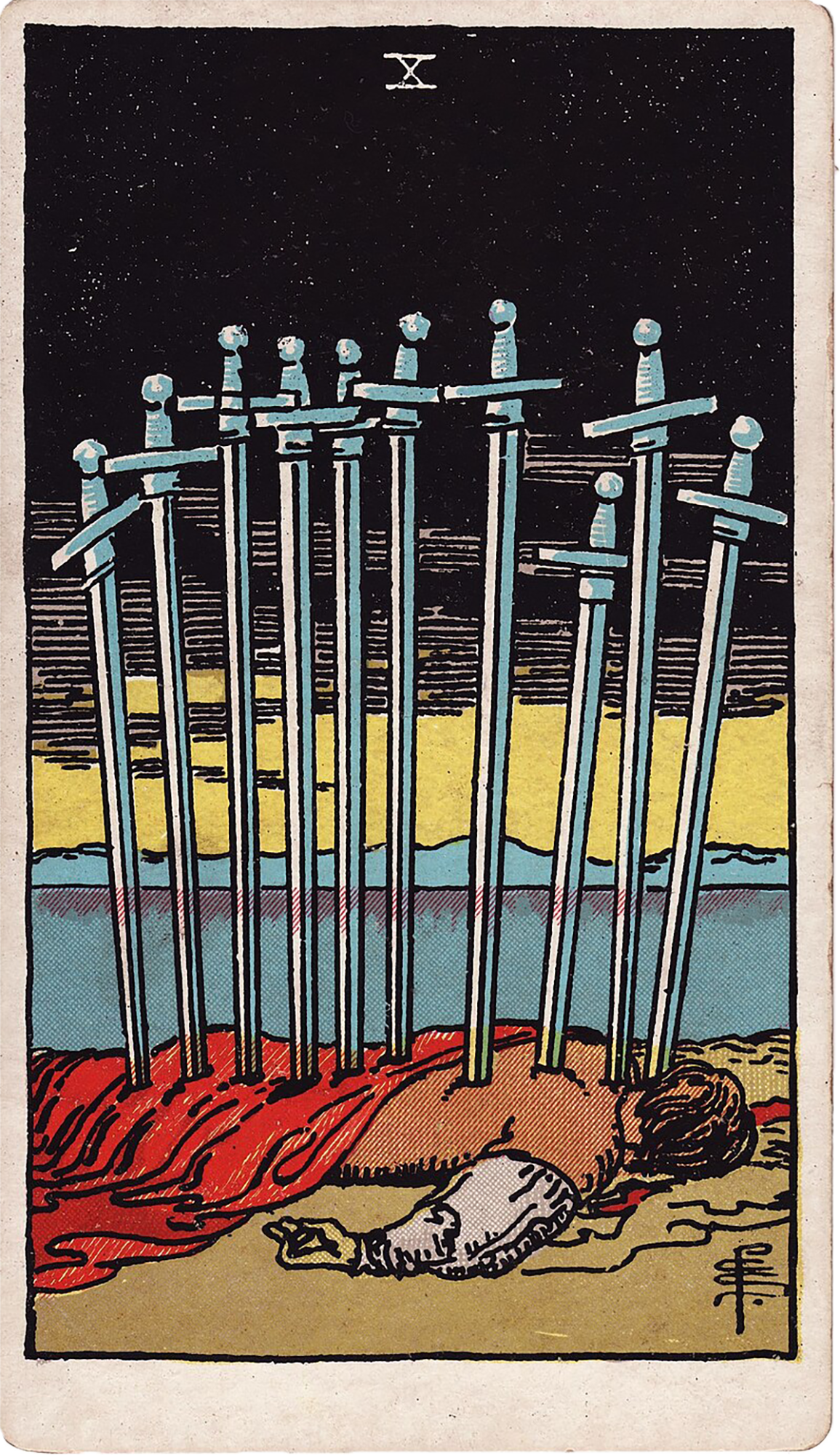 10 of Swords
Introduction to the supplied 10 of Swords image and core meanings
The supplied 10 of Swords appears in two orientations: upright and reversed. The upright 10 of Swords highlights that a painful cycle has reached a limit; the image is dramatic, yet a dawn on the horizon implies that once an ending is accepted, recovery can begin. The card is practical: it asks for a response that fits the present stage rather than an abstract ideal. The supplied reversed text directs attention to survival after crisis, resisting an ending, repeated collapse, or beginning to recover from a period that felt overwhelming. The reversal can show too much of the card's usual energy, too little of it, or a situation where the lesson is understood intellectually but not yet lived. It can also show that the issue is occurring internally and is not obvious to others. Rather than treating reversed as simply the opposite of upright, the supplied guidance asks us to examine where the process has become stuck and what needs to be simplified, acknowledged, practiced, released, or communicated before healthier Swords energy can return. This article is written for learners who use the supplied card images in single-card contexts. It will repeatedly refer to visual details in those images and use the supplied upright and reversed text to anchor interpretations across love, career, money, advice, challenge, person, outcome, and spiritual reflection contexts.
Reading the image closely the Rider-Waite-Smith symbolism that matters
If you have the supplied 10 of Swords image in front of you, orient your attention to these core symbols and their conventional RWS meanings. The figure is prone, face down, with ten swords piercing the back. This communicates an extreme ending or collapse that feels final. The dark sky over the figure shows crisis, fear, and the heaviness of mental anguish. Yet along the horizon a bright line of sunrise or dawn appears, signaling that this dramatic moment sits at the boundary between night and day, despair and the possibility of recovery. Mountains and a body of water in the background suggest that the scene is part of a larger landscape; endings have context and are not the whole story. On the RWS card the fallen figure wears black and red clothing and a spiked crown lies nearby. The crown can signify a shattered sense of identity, failed authority, or the loss of a role. The ten swords represent an accumulation: each sword is a thought, belief, critique, accusation, or decision that has been driven to a conclusion. Swords are the suit of thought, communication, conflict, strategy, and consequence, so the visual summons are intellectual and communicative as much as physical. When the card is upright, lean on the dawn as interpretive balance: the crisis is ending, and acceptance opens the door to recovery and planful action. When reversed, use the supplied guidance: the process may be internalized, repeated, resisted, or partially resolved. Reversal asks you to identify where inertia or avoidance is blocking healthier Sword energy such as honest communication, clear thought, or decisive boundary-setting.
How the supplied upright and reversed texts guide interpretation
The supplied upright text is action-oriented and stage-sensitive: it invites readers to consider where the pattern is already visible and what action would strengthen a constructive side. Upright 10 of Swords often means a limit has been reached and the present task is to respond to reality rather than to an ideal. Practically, that might mean grieving, disengaging, or making a clean break so you can plan recovery. The supplied reversed text reframes the card as attention to process: survival, recovery, resisting an ending, or a lesson understood intellectually but not fully integrated. Reversed asks the reader to look for where the process is stuck and what needs simplification, acknowledgment, practice, release, or communication. It also reminds you to consider internal dynamics that may be invisible to others. Use these two supplied orientations as lenses rather than as fixed labels. Ask whether the querent is at the point of acceptance and reconstruction (upright) or in repetition, denial, or early recovery that still requires integration (reversed). Those are the two main interpretive pathways you will walk through the contexts below.
Single-card technique the step-by-step method
A single-card reading is compact and potent. Follow a clear method so the 10 of Swords yields useful, actionable insight. 1) Observe first. Note whether the supplied 10 of Swords is upright or reversed. Look closely at the image: the placement of swords, the horizon, the character's clothing, the crown. Let the card speak before you apply keywords. 2) Name the energy. Using the supplied texts, decide: is this a limit/end that must be accepted (upright) or a stuck/recovering process that requires inner work or simpler structures (reversed)? 3) Place the card in context. Ask the single contextual question you promised to answer. For example, if the context is career, ask What does the 10 of Swords mean for the querent's job now? If love, ask What is ending or needing acceptance in this relationship? 4) Identify Swords functions at play. Are thought patterns, conversations, decisions, or conflicts driving the situation? The image of ten swords suggests multiple mental factors or repeated narratives. Name which ones are most salient for the querent. 5) Clarify action vs acceptance. Use the supplied upright text to differentiate tasks suitable to ending and recovery and the reversed text to find what needs practicing or releasing. State concrete next steps: who to tell, which boundary to set, what to stop doing. 6) Use timing and stage language. Avoid absolute predictions. Instead say whether the querent is at the initiation of an ending, at its peak, or moving into recovery. The sunrise in the image helps you lean toward a recovery stage in upright positions; reversed often implies earlier or stalled phases. 7) Anchor in compassion. The 10 of Swords can be shocking. Use gentle phrasing, emphasize possibility and practical steps, and name the feelings the card invites: grief, relief, exhaustion, small hope. 8) Invite follow-up. Single-card work is a snapshot. Suggest a short journal prompt or a two- or three-card follow-up spread to clarify immediate actions.
Interpreting the supplied 10 of Swords across contexts
Below are concise reading templates that rely on the supplied image and texts. Each template includes upright and reversed phrasing, an example of a concrete question to ask the querent, and suggested next steps. Love and relationships - Upright: The supplied image shows an ending that must be acknowledged. In a relationship, this often points to a breakup, the conclusion of a role, or the collapse of a repeating painful dynamic. The dawn suggests that accepting the truth will free space for recovery. Ask: What pattern has been allowed to continue past its usefulness? Next steps: clarify boundaries, allow grieving, refuse restarting old cycles without new agreements. - Reversed: The reversal often indicates resistance to ending, cyclical breaks and reunions, or recovery that is partial. The pain may be internalized and hidden. Ask: Are you trying to fix something that requires letting go? Next steps: practice honest conversations, simplify expectations, seek small consistent behaviors that rebuild trust rather than heroic gestures. Career and work - Upright: The supplied image can represent a role, project, or approach that has reached its limit. This could be getting laid off, the failure of a plan, or the moment to resign from a position that no longer fits. The dawn signals that a practical restructuring and new strategy can follow. Ask: What outcomes are no longer salvageable, and what skills can you repurpose? Next steps: make a pragmatic exit plan, document accomplishments, network strategically. - Reversed: The card may show burnout, a repeated cycle of stressful jobs, or clinging to a failing role. It can also mean the crisis is internal, such as sustained negative self-talk. Ask: Where are you repeating patterns that keep landing you in breakdown? Next steps: simplify workload, renegotiate responsibilities, develop a sustainable routine. Money and material resources - Upright: Financial collapse, an overdue bill catching up, or the end of a support system can be shown. The supplied image asks for practical triage and acceptance so recovery can begin. Ask: What debts or habits are non-negotiable to resolve now? Next steps: create a short-term survival plan, prioritize essentials, seek community assistance or professional advice. - Reversed: Reversed often signals the beginning of recovery from financial shock or an internal denial of the true state. It may also show repeated missteps. Ask: Which money stories are keeping you stuck? Next steps: simplify spending, set a tiny consistent saving habit, and practice honest budgeting conversations. Advice and guidance - Upright: The supplied 10 of Swords advises acceptance and action aligned to the present stage. It is not a call for dramatic heroics but for pragmatic, sometimes painful closure. Suggestions: let go of what cannot be changed, communicate the necessary truth, preserve energy for rebuilding. - Reversed: Advice focuses on integration and on identifying stuck points. Simplify choices, rehearse difficult conversations, and practice mental habits that prevent relapse into old patterns. Challenge and obstacle - Upright: The obstacle is the end itself or the trauma of a public collapse. The task is to name the end and make a plan to recover. The obstacle can be grief, shame, or legal/administrative fallout. - Reversed: The obstacle is resistance to closure or the internalization of collapse. The task is to simplify and practice new patterns. Person or personality - Upright: As a person, the supplied image can represent someone who appears defeated or who has recently experienced a public failure. They may be exhausted but near a recovery stage. - Reversed: It may represent someone who survives crises repeatedly, who resists letting go, or who intellectually understands change but fails to act. This person might hide their turmoil. Outcome and spiritual reflection - Upright: Outcome leans toward finality followed by the possibility of renewal. Spiritually, the card can be a dark night framed by dawn: necessary endings that clear space for new perspective. - Reversed: Outcome points to slow recovery, relapse, or the need for inner work to integrate lessons. Spiritually, it often asks for practices that make the lesson lived rather than merely known.
Examples and mini case studies
Example 1 career collapse upright A querent pulls the supplied upright 10 of Swords and asks about their job. You notice the ten swords and the dawn, and you name the situation: their current position has reached a limit after months of organizational changes. You say: The card shows an ending that needs to be acknowledged. On a practical level, negotiate your exit, gather paperwork, and plan a 90-day recovery strategy that focuses on skills you can repurpose. Emphasize recovery language: this is not a moral failure but a situational endpoint. Example 2 relationship reversed A querent asks about whether to leave a long relationship and draws the supplied reversed 10 of Swords. You recognize the reversal voice in the supplied text: resistance and partial recovery. You explore whether they are caught in cycles of breakups and reunions. You ask for examples of what repeats. The reading suggests they may understand why the relationship is harmful but keep returning because of familiarity or fear. Practical steps: small behavioral experiments such as a one-month no-contact window, or consistent couple therapy where small relational contracts are practiced. Example 3 money upright For a querent facing bankruptcy, the upright supplied card points to an ending of a financial chapter. The reading names triage actions: apply for emergency assistance, prioritize rent and food, and reach out to a legal/financial counselor. Reassure them that the dawn indicates the possibility of rebuilding credit and sustainable systems. These case studies show how imagery informs recommended steps and how the supplied upright and reversed texts shape the tone of advice.
Common mistakes and how to avoid them
1) Treating 10 of Swords as absolute doom. Many learners read this card as an apocalyptic sentence. Avoid that by always noting the dawn in the image and by using stage language. The card marks an ending, not the end of the querent's life. 2) Ignoring reversal nuance. Reversed 10 of Swords is not simply the opposite of upright. The supplied reversed text emphasizes internalization, survival, and stuck processes. Use reversal to diagnose what is resisting transformation. 3) Moralizing endings. Do not imply that the querent is "punished" or "deserves" what happened. The RWS image and supplied texts frame endings as factual stages and opportunities for practical recovery. 4) Overloading action. The card asks for appropriate response to the stage. Upright often needs acceptance and triage before ambitious projects. Reversed asks for small consistent practice. Avoid prescribing epic transformations when simple steps are needed. 5) Skipping emotional validation. The image is dramatic; readers must respect the querent's grief and exhaustion. Always name emotions before moving to action. 6) Assuming external visibility. The supplied reversed text warns that the issue may be internal and not obvious. Ask questions that reveal private mental patterns or suppressed grief.
Practical reading phrases and questions to use in sessions
Phrases that soften and clarify - The card is showing a hard ending, and also a first line of dawn. Let us name both. - This looks like a limit has been reached. The next real work is practical: who needs to be told, and what paperwork must be done? - There may be repetition here. Are you in a pattern that keeps returning you to this moment? Diagnostic questions - Which part of this feels most finished to you: a role, a belief, or an agreement? - What would acceptance look like in the next 24 hours? - Where are you holding on because of fear rather than because it still fits? Action-oriented prompts - Name three tiny actions you can take that protect your energy this week. - If you could write a short goodbye letter to one role you are ready to leave, what would you say? - What conversations need to happen before you step away? Who can you ask to help manage the practical fallout? Integration prompts for reversed situations - List one belief about yourself that keeps repeating and pick one tiny experiment to test it. - Practise a five-minute clarity ritual each morning: note one decision you will stop agonizing over. Using these phrases helps the querent move from shock to plan without bypassing grief or realism.
Rituals, practices, and recovery actions aligned with the card
Because the supplied 10 of Swords links ending and dawn, recommended practices honor both grief and rebuilding. Grief and release - Micro rituals: write a brief release letter and burn it or shred it safely to symbolize letting go. - Grieving timeline: set a bounded period for active grief practices (two weeks, one month) and plan small re-engagement tasks after that. Cognitive and communication work - Thought audits: list recurring negative thoughts and pick one to test with evidence each day. - Communication rehearsal: role-play a difficult conversation for two minutes to reduce catastrophic thinking. Practical triage - One-week survival plan: list essentials, resources, and one contact who can help manage urgent tasks. - Documentation: gather important documents now so endings do not become messier later. Slow rebuilding - 90-day skills plan: choose one marketable skill to sharpen and set three small measurable targets. - Community integration: find a support group, coach, or peer who has been through similar endings. Spiritual and reflective practices - Dawn meditation: use the card image to reflect on the horizon line as a metaphor for small openings of hope. - Ritual of witness: invite a trusted person to witness your decision and hold you accountable to practical next steps. These actions align with the card's invitation to be realistic while remaining oriented toward renewal.
Closing summary and ethical reading tips
The supplied 10 of Swords is a strong teacher about endings, resilience, and renewal. Upright, it often signals that a painful cycle has reached a limit and that acceptance will allow recovery to begin. Reversed, it draws attention to survival after crisis, resistance to endings, repeated collapse, or incomplete integration. Always read the card within context: use the image to anchor compassionate language, name mental and communicative dynamics, and offer concrete steps that match the querent's stage. Ethical tips for readers - Prioritize safety: if the card suggests severe psychological crisis, encourage professional help rather than only metaphysical advice. - Avoid certainty: the 10 of Swords marks a likely endpoint or pattern, but not an unchangeable fate. - Hold compassion: treat endings as real losses and avoid platitudes that minimize pain. Use the supplied upright and reversed texts as interpretive scaffolding. Let the image itself guide you toward both grief and hope, toward naming limits and toward careful rebuilding. With practice, the 10 of Swords will become a precise tool for diagnosing what must be concluded and what practical steps will lead to resilient renewal.
Practice questions
• Looking at the supplied 10 of Swords image, which detail catches your eye first and why
• Is your current situation closer to the card's upright acceptance stage or the reversed stuck/recovery stage
• What thought patterns correspond to the ten swords in your life right now
• What small practical action could you take this week that accepts loss rather than denies it
• Who would serve as a practical witness for the ending you need to name
• Which part of this process feels internal and hidden from others
• How can you translate the card's dawn into a 90 day recovery plan
• What belief would you simplify, practice, or release to move toward healthier Swords energy
Comments
Sign in to comment.
Continue learning
Interpreting the Dance of Justice and The Devil: Balancing Morality and Temptation in Tarot Readings
The combination of Justice and The Devil in tarot presents a profound exploration of morality, temptation, and personal accountability. This article unpacks how these cards influen...
Understanding The World Card in Personal Completion and New Cycles
The World card in tarot signifies completion, integration of lessons learned, and the threshold of new cycles. This article explores its nuanced meanings in upright and reversed po...
Mastering Tarot Timing Techniques for Accurate Readings
Timing in tarot readings can transform vague predictions into clear guidance about when events might unfold. This article explores practical timing techniques for beginners and adv...
Unlocking the Power Balance of The Emperor The Hierophant and Justice in Tarot Combinations
This article offers a deep exploration of the combined meanings of The Emperor, The Hierophant, and Justice cards within tarot spreads, focusing on how their energies interact to p...
Unlocking Leadership Qualities Through the Knight Queen and King of Wands
The Knight, Queen, and King of Wands embody evolving leadership qualities within the family suit of Wands. This article unpacks their traditional symbolism and the lessons each cou...
Mastering the Art of Combining The Magician The Empress and Ace of Pentacles for Manifestation and Abundance
This article offers a comprehensive exploration of how to skillfully combine The Magician, The Empress, and Ace of Pentacles tarot cards to enhance manifestation and attract abunda...
Mastering Intuitive Tarot Reading with The High Priestess The Hermit and The Moon for Deeper Insights
This article guides Tarot readers through mastering intuitive reading skills using three powerful cards: The High Priestess, The Hermit, and The Moon. It covers both beginner and a...
Unlocking Leadership and Responsibility Lessons Through the Court Cards of Swords
This article delves into the Court Cards of Swords—the Page, Knight, Queen, and King—to uncover the nuanced lessons they provide about leadership and responsibility. Rooted in the...
Exploring the Symbolic Language and Elemental Correspondences of the Court Cards of Cups for Emotional and Intuitive Insight
This in-depth article examines the Court Cards of Cups within the Rider-Waite-Smith tradition and the VoxFati Tarot Library context. It explores their rich symbolism and elemental...
Interpreting the Page of Swords for Career Love and Personal Growth
This article teaches how to read the supplied Page of Swords single-card draw across multiple life contexts. Using the card's Rider-Waite-Smith imagery and the provided upright and...