
Tracing The Origins And Common Questions About The Magician Card In Tarot History
The Magician card holds a unique place in Tarot history as a symbol of skillful action, communication, and the transformation of potential into reality. This article traces its historical origins, explores its traditional Rider-Waite-Smith symbolism, and addresses common questions and interpretive challenges. Learners will gain practical guidance on reading The Magician upright and reversed, understanding its nuanced meanings, and applying these insights consciously in Tarot practice.
Cards explored in this article
 The Magician
Introduction to The Magician Card and Its Significance
The Magician occupies the first position in the Major Arcana of many traditional Tarot decks, typically numbered as one following The Fool (which is zero). This placement already gives The Magician a foundational role in Tarot's structure, symbolizing the moment when potential — represented by The Fool’s innocence and openness — becomes manifest through deliberate action. Historically, The Magician is often depicted as a figure wielding symbols from the four Tarot suits, emphasizing mastery over the elements and the ability to create through focus and willpower. This article will focus on the traditional Rider-Waite-Smith iconography of The Magician, as supplied, interpreting the card's upright and reversed meanings, and responding to frequent questions learners ask about its use and context.
Historical Origins of The Magician Card
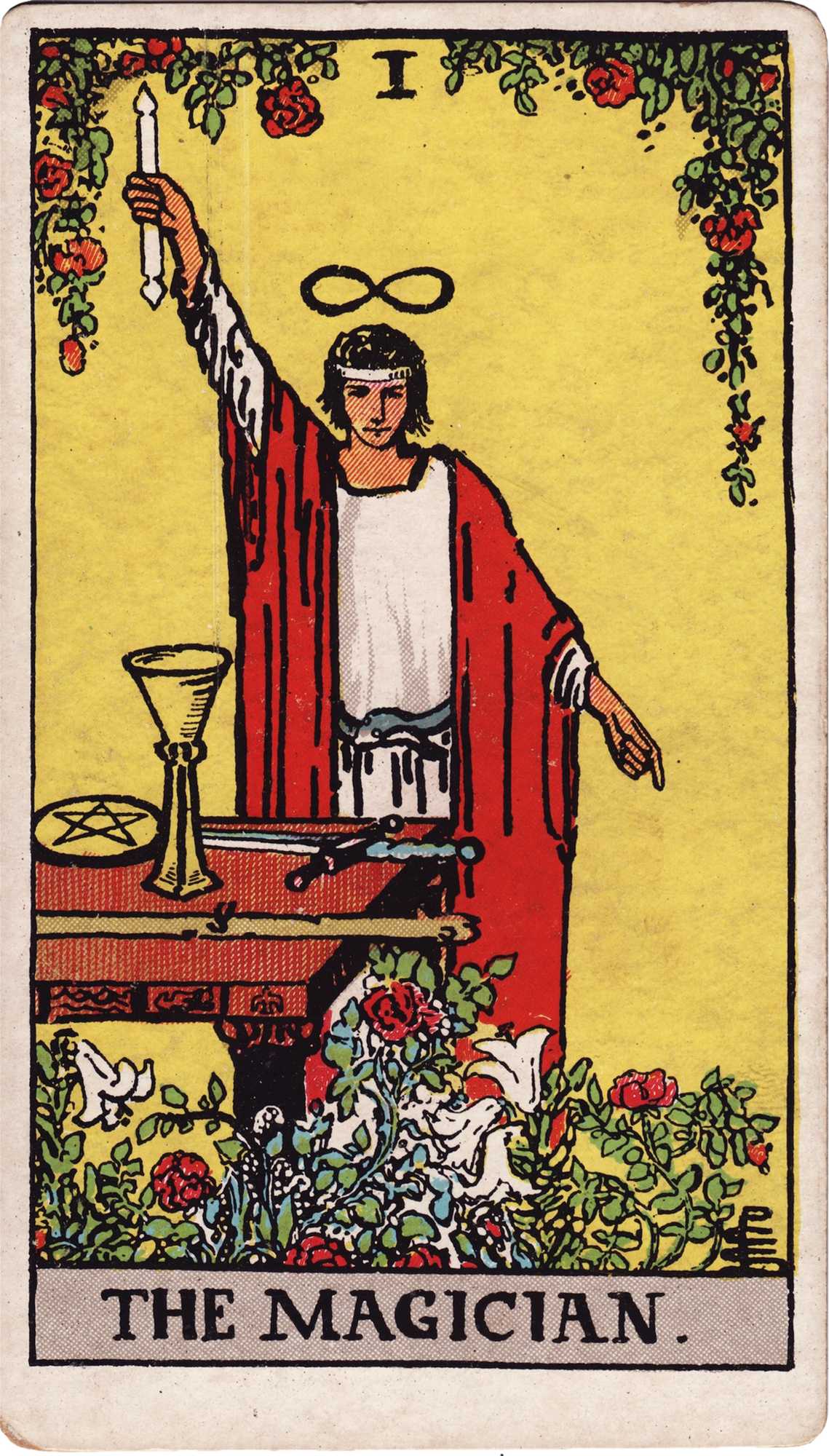
The Magician card’s roots can be traced back to early Italian and French Tarot decks from the 15th century, where the figure was often called "Il Bagatto" or "Le Bateleur," terms meaning "the trickster" or "the juggler." This echoed medieval and Renaissance ideas of magicians, alchemists, and street performers who manipulated objects and perceptions with skill and cunning. Over time, this evolved into a more positive archetype representing conscious skill, creativity, and the harnessing of natural forces. The Rider-Waite-Smith deck, designed by Arthur Edward Waite and illustrated by Pamela Colman Smith in 1909, refined this symbolism into a more esoteric and structured form. The Magician is shown standing before a table holding the four symbols of Tarot suits — a cup, pentacle, sword, and wand — representing emotional, material, intellectual, and spiritual tools respectively. His right hand points upward while his left points to the earth, reflecting the Hermetic principle "As above, so below," linking the divine and earthly realms.
Symbolism and Imagery in the Rider-Waite-Smith Magician Card
In the Rider-Waite-Smith (RWS) Magician card, the figure is central with a confident stance, surrounded by symbols that encode its meaning. The infinity symbol (lemniscate) above his head suggests limitless potential and eternal cycles. The red and white clothing symbolizes the balance of passion and purity, action and thought. The table before him displays the four suits, reminding the reader that the Magician has access to all fundamental energies and resources. The raised right hand with a wand directs energy from the spiritual realm, while the left hand points downward, grounding that energy into the physical world. This dynamic posture encourages readers to consider how they can deliberately use their own skills and resources to manifest change. The lush garden background indicates growth and fertility — a fertile ground for ideas and actions to flourish.
Common Questions About The Magician Card in Readings
Many learners ask about the practical meaning of The Magician in a reading. Upright, The Magician suggests the querent has the tools, talents, and clarity to make a decisive first move. It calls for deliberate skill, focused communication, and conscious choice rather than passivity or waiting. Common questions include: “Does The Magician mean success is guaranteed?” The answer is no — it represents potential and readiness, not guaranteed outcomes. Another frequent question is how to differentiate The Magician from other cards indicating action, such as The Chariot or Ace cards. The distinction lies in The Magician’s emphasis on using existing resources consciously and communicating intentions clearly as the first step in a process. Reversed, the card often raises concerns about manipulation, dishonesty, or lack of focus. Learners frequently ask if reversed means “bad luck” or failure; instead, it signals blockages or distortions of The Magician’s positive qualities and invites reflection on integrity and balance.
Interpreting The Magician Upright in Practical Readings
When The Magician appears upright, it encourages the reader to identify where deliberate skill and clear communication can move the situation forward. For example, if a querent is facing a new project or decision, The Magician asks: “What tools do you already have? What can you do now to take the next step?” This card suggests that the major issue is visible enough to engage with consciously, even if the entire path is not yet clear. Reading The Magician is most effective when you notice which part of the card’s lesson is already present in the querent’s behavior or environment. Are they already using their talents but need more focus? Are they about to make a first concrete move after reflection? Unlike cards suggesting external forces, The Magician stresses internal agency and deliberate choice.
Understanding The Magician Reversed and Its Nuances
The reversed Magician brings attention to challenges such as self-doubt, scattered energy, or manipulation. It may reflect a period when the person’s talents feel blocked or the communication is unclear or dishonest. Reversal is not inherently negative; it can mark a psychological phase where old patterns are recognized but not yet changed. In practical reading, the question shifts from “What can I do?” to “Where is this energy distorted or difficult to access?” For example, a reversed Magician might warn against overconfidence or using cleverness without integrity. It can also indicate a private, internal process of realizing these issues. Surrounding cards help clarify whether the reversal signals resistance, recovery, or temporary pause.
Common Mistakes and How to Avoid Them When Reading The Magician
A common pitfall is interpreting The Magician as a simple good luck card or as a sure sign of success. Instead, it represents potential and deliberate skill that must be consciously applied. Similarly, readers sometimes view reversed Magician as a purely negative omen; instead, it invites nuanced inquiry into blockages or distortions. Another mistake is ignoring the multiple symbolic elements on the card, such as the infinity symbol or the table with suit symbols. These details ground interpretation in the card’s deeper meaning of balanced mastery over mind, body, emotion, and spirit. Effective reading requires attention to these details and awareness of where the querent is in relation to the card’s archetype.
Techniques for Anchoring Interpretation in Visual and Symbolic Details
To deepen understanding and ensure visually anchored interpretation, learners should actively engage with the card’s imagery. Note the figure’s posture: the one hand pointing upward and the other downward symbolizes bridging the spiritual and material worlds. Observe the infinite loop above the head representing limitless creative potential. The four suit symbols on the table are tangible tools available for manifestation — how do these suits relate to the querent’s current challenges? Asking these questions grounds interpretation in the card itself rather than relying on vague impressions. Using the supplied Rider-Waite-Smith Magician card image as a reference, practice describing each symbol and relating it to the querent’s situation.
Practical Methods for Incorporating The Magician in Tarot Practice
When The Magician appears in a spread, start by identifying whether it is upright or reversed, then examine its position relative to the question or surrounding cards. Ask where deliberate skill, communication, or conscious choice is present or needed. Encourage querents to consider what resources are currently available rather than waiting for external conditions to change. Reflect on whether the card’s message is about initiating action, clarifying intentions, or recognizing blockages in personal power. Journaling about The Magician’s symbolism and how it appears in daily life can deepen connection to its archetype. For example, note moments when you consciously use your skills to create change or times when self-doubt interferes with your ability to act.
Conclusion and Reflection on The Magician’s Role in Tarot Tradition
The Magician card is a rich and multi-layered symbol within Tarot’s Major Arcana. Its historical lineage from medieval tricksters to esoteric magicians reflects changing cultural attitudes toward creativity, skill, and power. The Rider-Waite-Smith imagery beautifully captures its core message: the conscious transformation of potential into action through deliberate choice and clear communication. Learners benefit from understanding The Magician not as a promise of automatic success but as an invitation to engage consciously with one’s talents and environment. Both upright and reversed positions offer valuable lessons about balance, integrity, and focus. Anchoring interpretation in the card’s rich symbolism supports a nuanced and empowering Tarot practice.
Practice questions
• In what areas of your life do you feel you have untapped skills or resources that could help you take a deliberate first step?
• How do you currently communicate your intentions, and where might clearer boundaries or honesty improve your outcomes?
• When you face a challenge, are you more likely to hesitate waiting for certainty or engage with what is available now?
• Have you noticed situations where your talents become scattered or your cleverness feels unbalanced? How might you restore integrity and focus?
• How can the Hermetic principle "As above, so below" be applied to your understanding of personal power and manifestation?
Comments
Sign in to comment.
Continue learning
The Fool in Life Transitions and New Beginnings
The Fool card embodies the spirit of beginnings, curiosity, and the leap of faith required during life transitions. This article explores The Fool’s meanings across various reading...
Unlocking the Energies of the King Queen and Knight of Cups for Emotional Intelligence
This article delves into the King, Queen, and Knight of Cups from the Minor Arcana's family Suit and Court Cards, emphasizing how these archetypes embody stages and expressions of...
Unlocking Personality Traits Through the Court Cards of Pentacles
This article delves into the personality traits and life lessons embodied by the court cards of Pentacles: Page, Knight, Queen, and King. Grounded in the practical symbolism of the...
Integrating The Fool and The World to Chart the Journey of Tarot Initiation
This article explores the integration of The Fool and The World cards as symbolic bookends in the Tarot journey, emphasizing their complementary lessons for initiates. Drawing on t...
Unlocking Personality and Leadership Qualities with the King Queen and Knight of Pentacles
This article delves into the King, Queen, and Knight of Pentacles court cards within the Minor Arcana, focusing on their symbolism of personality traits and leadership within the f...
Unlocking the Roles and Personalities of Page Knight Queen and King of Swords
This article delves deeply into the family suit lessons of the Page, Knight, Queen, and King of Swords, exploring their roles and personalities within the Minor Arcana. Anchored in...
Unlocking Personality Insights Through the Court Cards of Cups
The Court Cards of Cups offer a rich framework for understanding emotional personality traits, interpersonal dynamics, and intuitive processes. This article guides learners through...
Unlocking the Dynamic Partnership of The Magician and The High Priestess in Tarot Combinations
The Magician and The High Priestess represent two complementary archetypes in the tarot deck that, when combined, offer a rich interplay of conscious action and intuitive insight....
Unlocking Leadership Styles Through the King Queen and Knight of Swords
This article delves into the leadership styles portrayed by the King, Queen, and Knight of Swords, court cards in the Minor Arcana’s Suit of Swords. By closely examining their Ride...
Unlocking Practical Wisdom and Ambition Through the Court Cards of Pentacles
This article delves deeply into the suit of Pentacles’ court cards—Page, Knight, Queen, and King—offering tarot learners a comprehensive understanding of their practical wisdom and...