
Two of Pentacles When You're Juggling Money Time and Change
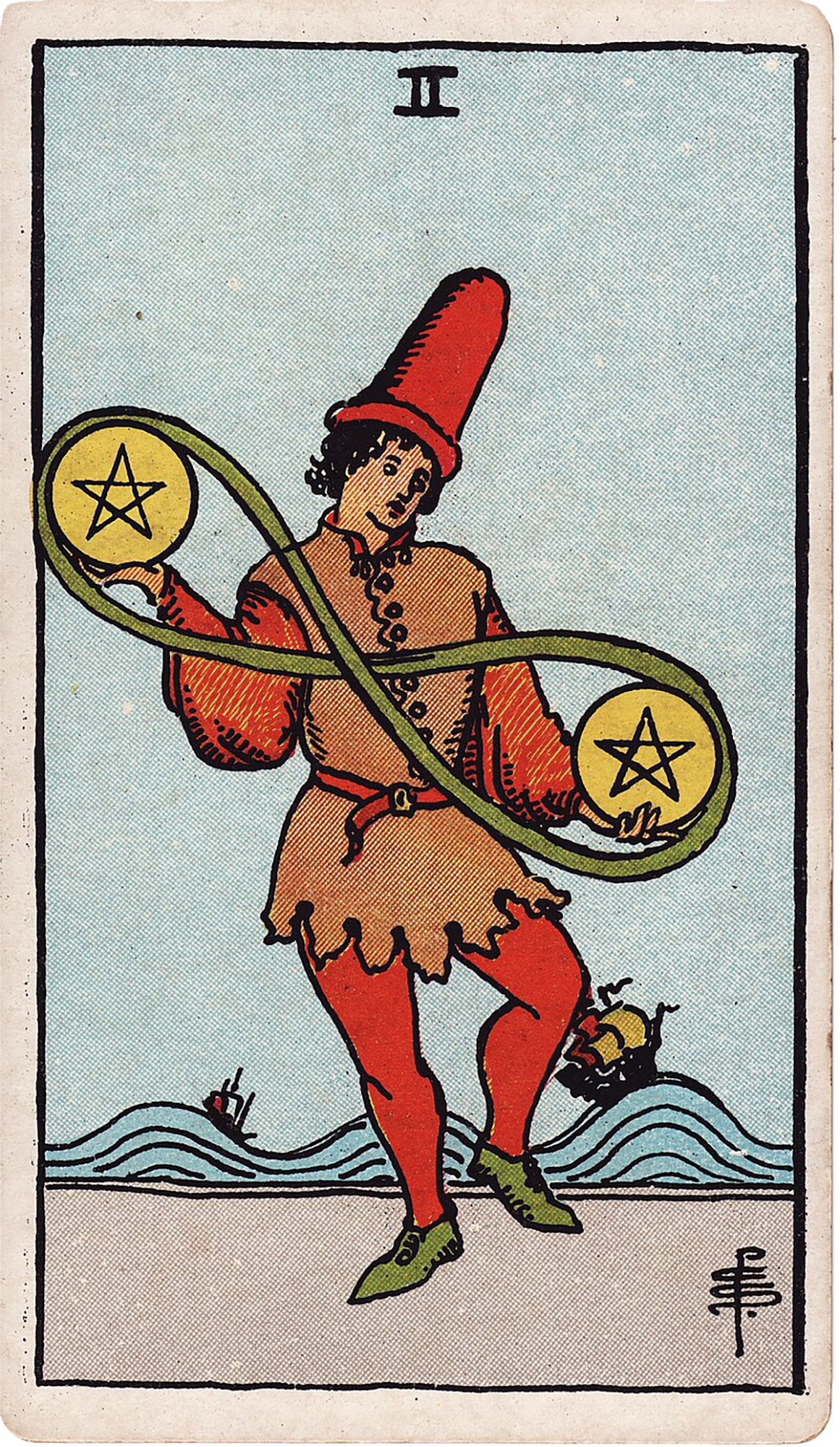
This article teaches how to read the supplied 2 of Pentacles image in multiple contexts. Using Rider‑Waite‑Smith symbolism—the man juggling two pentacles, the infinity ribbon, ships on a rough sea and distant mountains—we explore upright and reversed senses, practical reading techniques, common mistakes, and worked examples for love, career, money, advice, challenge, person, outcome and spiritual reflection. Emphasis is on learning method, asking clarifying questions, and translating active balance into concrete guidance rather than deterministic prediction.
Cards explored in this article
 2 of Pentacles
Introduction: Why the 2 of Pentacles is a lesson in active balance
Look at the supplied 2 of Pentacles image: a figure moves, actively juggling two pentacles linked by an infinity ribbon while ships ride a choppy sea behind him and mountains rise in the distance. That scene is the card’s grammar. In the Rider‑Waite‑Smith tradition the suit of Pentacles governs work, money, health, routine, craft, the body and long‑term material stability. The supplied upright and reversed texts describe how that grammar plays out: upright, flexible management of changing priorities; reversed, the point where juggling breaks down into overcommitment or disorganization. This article teaches how to read this single card across practical contexts so you can translate the visual cues into meaningful, actionable guidance when the 2 of Pentacles appears in a spread.
Key imagery and what it signals
Anchor every interpretation to the details on the supplied 2 of Pentacles. The central figure is not still; balance here is active, not static. The two pentacles he handles represent two areas of value—income streams, responsibilities, projects, relationships, health vs. work—and the infinity ribbon that links them suggests an ongoing, repeating dynamic rather than a one‑time choice. The ships on the rough sea indicate external turbulence: changing markets, shifting schedules, emotional waves, or health ups and downs. The distant mountains suggest long‑term terrain and the idea that what’s being juggled can have consequences for stability or future plans. In readings, ask which of these visual metaphors maps to the querent’s life: what are the two ‘pentacles’? What is the turbulent sea? What is the long view represented by the mountains?
Upright 2 of Pentacles: constructive juggling
Use the supplied upright text as a starting point: Upright, 2 of Pentacles highlights managing changing priorities with flexibility; balance here is active and responsive rather than perfectly still. The card emphasizes practical responses to current demands—use the suit skills: work, money, health, routine, resources, craft, body and long‑term material stability. In practice this means the querent has the skills to adapt: they can reallocate time, switch priorities, and keep systems running through change. But the image warns that this is effortful—balance is maintained through movement. In a spread, the upright 2 of Pentacles often recommends incremental, pragmatic actions: adjust the budget now, renegotiate timelines, alternate attention between responsibilities, or adopt a rotating schedule. Look at surrounding cards to determine whether this juggling is beginning, stabilized, under pressure, or moving toward resolution.
Reversed 2 of Pentacles: when juggling becomes unstable
The supplied reversed text frames reversal not simply as the opposite of upright but as a sign of where the process is stuck: Reversed, 2 of Pentacles draws attention toward overcommitment, disorganization, financial strain or the moment when too many moving parts can no longer be managed casually. The reversal might show too much of the card's usual energy—endless juggling with no rest—or too little, where the lesson is known in theory but not enacted. When you see the reversed 2 of Pentacles, read for collapse points: missed payments, burnout, responsibilities that are invisibly piling up, or internal conflict where the person presents adaptability yet feels overwhelmed. The right question becomes: what needs to be simplified, released, practiced, or communicated to restore a healthier expression of Pentacles?
How to place the 2 of Pentacles in a spread: practical technique
This is a single‑card focus, but placement still changes tone. If the supplied 2 of Pentacles appears in a position labeled 'Present', take the image as describing current juggling that requires attention now. In a 'Challenge' position the card indicates the juggling itself is the problem or that external flux is testing resources. In an 'Advice' slot it instructs active prioritization and small, practical adjustments. For 'Outcome', the 2 of Pentacles usually forecasts continued negotiation—either successful adaptive balance (upright) or a warning to simplify (reversed). As technique, always ask: what are the two (or more) items being balanced? Next, map each visual element to practical domains: pentacles = money/skill/routine; sea = external change; mountains = long‑term consequences. Write those mappings down before interpreting, and use targeted questions to the querent to confirm or refine them.
Contextual readings: love
Upright in love: The supplied 2 of Pentacles suggests managing two priorities—perhaps balancing a relationship with work, family obligations, or another partnership. The image’s motion tells you this is an active negotiation: schedules are shifting, and flexibility will carry the day. Ask whether the 'two pentacles' are two people, relationship and career, or two distinct emotional needs. Advice: create predictable windows of attention and swap roles intentionally—small rituals, shared calendars, and check‑ins. Reversed in love: The juggling has become a strain—someone may be emotionally distant because they're overworked, or there could be hidden parallel relationships. The reversal asks what to simplify: reduce commitments, make boundaries clear, or admit when a situation can’t be held together as before. In both cases, refer back to the image: is the querent the moving juggler, or are they watching someone else on the deck while storms toss the ships?
Contextual readings: career and work
Upright in career: The supplied 2 of Pentacles usually shows competent multitasking—managing two projects, a day job plus freelancing, or shifting roles in a fluid workplace. The infinity ribbon hints that this juggling may be ongoing rather than temporary. Recommended actions include formalizing a rotation of tasks, documenting workflows, and using time‑boxing methods. The ships suggest external market changes—be prepared to pivot. Reversed in career: The card signals overload, missed deadlines, or inconsistent income streams. The reversal asks whether the juggling is hide‑and‑seek with hidden inefficiencies: unclear scope, poor delegation, or inadequate systems. Concrete steps: reduce active projects, renegotiate scope, hire temporary support, or return to a single focus until processes stabilize.
Contextual readings: money and resources
Upright in money: The figure juggling two pentacles can represent two income sources, cyclical cash flow, or balancing savings and spending. The infinity ribbon suggests a recurring pattern—seasonal earnings or rolling transfers between accounts. Practical moves: create buffers (small emergency fund), automate transfers, and forecast expected waves using the ships as a metaphor for volatility. Reversed in money: Financial juggling has become instability—late bills, debt juggling (moving balances), or ignoring budgeting. The right questions are operational: which accounts are being juggled, which payments are on autopilot, and where are late fees or interest eroding stability? Action: simplify automatic payments, consolidate debt where sensible, and create a short cash flow plan for the immediate turbulent period.
Contextual readings: advice and challenge
Advice (upright): Treat balance as practice. The supplied 2 of Pentacles recommends responsive systems rather than idealized stillness. Use a rotating schedule, micro‑habits, and checkpoints. Break tasks into digestible cycles, and commit to small experiments: try a two‑week adjustment and evaluate. Challenge (reversed): The card points to scope creep and misaligned commitments. The challenge is often organizational or communicative—someone assumes you can hold more than is reasonable. The remedy is not only to stop taking more but to say no, delegate, and clarify expectations. In both positions, the image teaches that balance is maintained by movement: stop expecting a single perfect solution and instead create sustainable rhythms.
Contextual readings: person and outcome
Person: Upright, someone represented by the supplied 2 of Pentacles is adaptable, resourceful, and used to shifting priorities—possibly an entrepreneur, parent juggling roles, or a freelance professional. They might present as easygoing, but under pressure their face can tighten: the image’s man juggles, yes, but he’s concentrating. Reversed, the person is overwhelmed, disorganized, or trying to hide chaos. They may be polite and capable but inconsistent. Outcome: Upright, the likely outcome is continued negotiation with adaptive systems—if the querent applies practical steps, they can hold the situation and even gain fluency in multitasking. Reversed, the likely outcome without change is breakdown: missed opportunities, strained relationships, or financial shortfall. The path forward is simplification and rebuilding processes.
Spiritual reflection: balance as practice rather than arrival
Use the supplied 2 of Pentacles to teach a spiritual concept: balance is not a static ideal; it’s an embodied practice. The infinity ribbon implies repetition and the need for continual attention. The turbulent sea says spiritual life also involves external storms—practice is how you respond. Upright offers a spiritual interpretation of skillful presence: keep returning to breath, to small grounding rituals that reorient you from panic into managed attention. Reversed asks you to examine attachment to holding everything at once. Spiritually, the lesson may be to surrender one thing for a season or to cultivate a practice of discernment—ask what is essential now versus what can wait. This reflection reframes material juggling as a field for disciplined presence.
Practical reading method and clarifying questions
A step‑by‑step method to work with the supplied 2 of Pentacles in a reading: 1) Identify whether the card is upright or reversed; use the supplied definitions as your base. 2) Map the two pentacles to real‑world elements: ask the querent 'If these are two things in your life, what are they?' Offer prompts: income vs expenses, job vs family, two projects, health vs social life. 3) Use the imagery to refine: 'What is the choppy sea for you—external changes, market volatility, emotional ups and downs?' and 'What do the mountains represent—long‑term goals or looming consequences?' 4) Ask clarifying action questions based on orientation: Upright—'Which small system can you implement this week to manage the rotation of attention?' Reversed—'What can you stop doing immediately to release pressure?' 5) Suggest two concrete next steps and a timeline (e.g., one budgeting task and one boundary for the week). This method keeps the reading anchored to visible imagery and practical outcomes rather than vague counsel.
Worked examples
Example 1 — Love (upright): Querent is single and draws the supplied 2 of Pentacles upright in the 'Present' position. Ask: are the two pentacles two potential partners or dating and career? The querent reveals two active dating tracks while starting a demanding job. Advice: set two evenings a week for dates and protect one weekend day for rest. The image’s moving balance suggests rotational attention will help. Example 2 — Career (reversed): Querent draws the supplied 2 of Pentacles reversed in 'Challenge.' They freelance and juggle clients with inconsistent payments. The reversed card indicates collapse points. Suggest immediate consolidation: stop taking new clients for 30 days, follow up on overdue invoices, automate invoicing, and set a bare‑bones budget. Example 3 — Money (upright): Querent sees two income streams—seasonal sales plus a steady job. Use the ships metaphor to forecast seasonal volatility and advise an emergency buffer and automatic savings transfer on paydays. Each example uses the card’s imagery as the interpretive anchor and translates visual metaphor into actionable steps.
Common mistakes when reading the 2 of Pentacles
1) Interpreting balance as 'no problem'—the image shows effort. Don't tell querents everything is fine when movement is required. 2) Treating reversal as just 'bad luck'—use the supplied reversed guidance: examine what’s stuck, what needs simplification. 3) Ignoring which two things are being balanced—always map the two pentacles concretely. 4) Overlooking external context—the ships and mountains matter; the juggling is affected by forces beyond the person. 5) Giving endless advice without prioritization—offer two immediate, practical actions rather than ten vague steps. Avoid these errors by keeping interpretations concrete, imagistic, and prioritized.
Techniques to deepen skill with this card
Practice exercises: 1) Daily mapping: when you draw the supplied 2 of Pentacles for yourself, list the two items you feel you’re balancing that day and one small act to rebalance. 2) Image journaling: sketch or write about the man, the ribbon and the sea—what feelings arise? 3) Timeboxing drills: set 25‑minute blocks alternating two tasks and assess your stress level after a week. 4) Reversal experiments: when you see the reversed form in practice readings, ask the querent to name one thing they can stop immediately; follow up in a session later. Reading tip: use the supplied card’s visual elements to create metaphors that are checkable—ask the querent to report back whether the 'ship' (external force) calmed after your suggested action. These techniques build an interpreter’s muscle for translating the card’s dynamic balance into real‑world change.
Conclusion: translate motion into manageable steps
The supplied 2 of Pentacles is a practical card about living in motion. Upright it celebrates adaptive competence; reversed it warns of overload or unintegrated habits. Whenever the card appears, anchor your reading to the image: name the two pentacles, identify the turbulent sea, and decide which mountain is the long view. Use concrete, prioritized steps: schedule, simplify, automate, delegate, and practice small, repeatable rituals. Teach querents that balance here is a skill, not a destination—an action plan plus honest limits will turn the card from a description into useful guidance.
Practice questions
• What are the two most important things I am trying to balance right now, and which feels heavier?
• When I picture the ships in the supplied 2 of Pentacles image, what external forces feel like they are rocking my life?
• Which small system (calendar, budget, delegation) could I implement this week to make juggling easier?
• If the supplied 2 of Pentacles were reversed for me, what would I need to stop doing immediately?
• How do I distinguish between a season of necessary juggling and a pattern that requires simplification?
• What one boundary can I set today that will protect my attention for the coming week?
Comments
Sign in to comment.
Continue learning
Interpreting the Dance of Justice and The Devil: Balancing Morality and Temptation in Tarot Readings
The combination of Justice and The Devil in tarot presents a profound exploration of morality, temptation, and personal accountability. This article unpacks how these cards influen...
Understanding The World Card in Personal Completion and New Cycles
The World card in tarot signifies completion, integration of lessons learned, and the threshold of new cycles. This article explores its nuanced meanings in upright and reversed po...
Mastering Tarot Timing Techniques for Accurate Readings
Timing in tarot readings can transform vague predictions into clear guidance about when events might unfold. This article explores practical timing techniques for beginners and adv...
Unlocking the Power Balance of The Emperor The Hierophant and Justice in Tarot Combinations
This article offers a deep exploration of the combined meanings of The Emperor, The Hierophant, and Justice cards within tarot spreads, focusing on how their energies interact to p...
Unlocking Leadership Qualities Through the Knight Queen and King of Wands
The Knight, Queen, and King of Wands embody evolving leadership qualities within the family suit of Wands. This article unpacks their traditional symbolism and the lessons each cou...
Mastering the Art of Combining The Magician The Empress and Ace of Pentacles for Manifestation and Abundance
This article offers a comprehensive exploration of how to skillfully combine The Magician, The Empress, and Ace of Pentacles tarot cards to enhance manifestation and attract abunda...
Mastering Intuitive Tarot Reading with The High Priestess The Hermit and The Moon for Deeper Insights
This article guides Tarot readers through mastering intuitive reading skills using three powerful cards: The High Priestess, The Hermit, and The Moon. It covers both beginner and a...
Unlocking Leadership and Responsibility Lessons Through the Court Cards of Swords
This article delves into the Court Cards of Swords—the Page, Knight, Queen, and King—to uncover the nuanced lessons they provide about leadership and responsibility. Rooted in the...
Exploring the Symbolic Language and Elemental Correspondences of the Court Cards of Cups for Emotional and Intuitive Insight
This in-depth article examines the Court Cards of Cups within the Rider-Waite-Smith tradition and the VoxFati Tarot Library context. It explores their rich symbolism and elemental...
Interpreting the Page of Swords for Career Love and Personal Growth
This article teaches how to read the supplied Page of Swords single-card draw across multiple life contexts. Using the card's Rider-Waite-Smith imagery and the provided upright and...